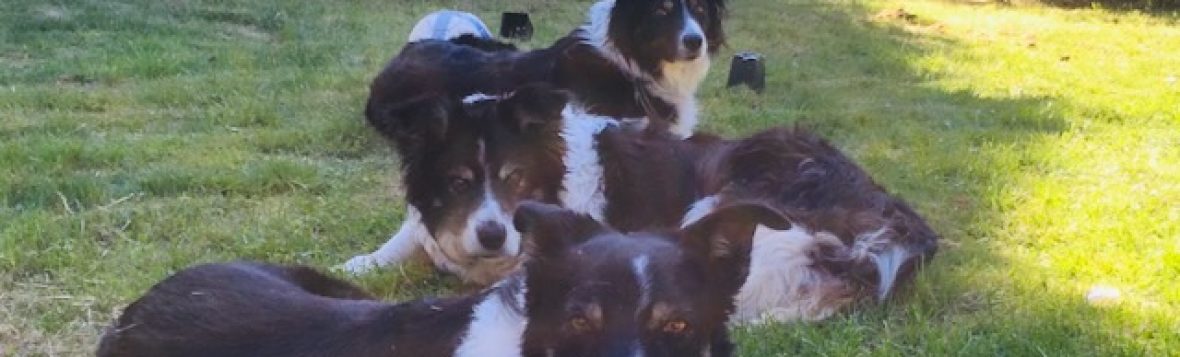
I am re-reading this log (as it was called then) 18 January 2021, after I heard from Ira, that Zhenya – Evgeny – had just died from COVID in a St Petersburg hospital. The snow came unexpectedly, I’d found a fur hat to wear, and Irena called me as I was walking the dogs. Zhenya has died of COVID, she said. I am back in Russia 1994 all day. Moscow, Ostashkov, St Petersburg where we camped, fought off mosquitoes, drank copious amounts of vodka, ate Bush Legs, all on a mission to sample the River Volga. I am so grateful to find my record of this time, which I read now, and copy into this blog.
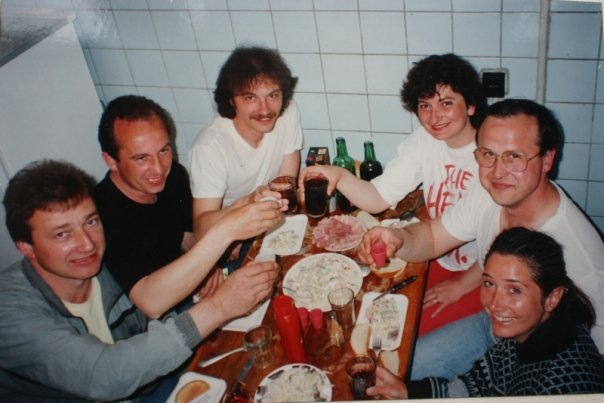
Background
To go or not to go to Russia with Bob? We had a post Caribbean meeting to discuss in the Brasserie du Marche, down the less fashionable end of Portobello Road (the Golborne Road end), an unpretentious little restaurant, small pine tables, unmatched chairs, a young cool owner who’d lived in France. Bob had taken me here after we’d first met, a year ago, in another restaurant, the trendy 192 more central Nottinghill. Then I was bleeding from Oxford John’s rejection and was numb, a natural barrier. We’d both had flings, I with the playful popinjay, Pip, and he with Claire, a vibrant Irish Greenpeace organiser. Bleeding cards still on the table, (no sex please, I am healing), I’d accepted Bob’s invitation to accompany him on a Caribbean sailing adventure. He’d chartered a Sloop 45′ to go round the Windward islands: crew were The Misfits, Bob, his son Calum and I and the A Team, his best friends, Caroline and her ex husband Robin, and their son Jake. It was not a successful medium: boat dynamics were uncomfortable from the start with a big back story. Suffice to say I soon realised one hired a boat to be isolated, like a pestered film star to be far from the madding crowd, which was fine if you were happy with the person/people you were isolated with. I longed for the madding crowd to avoid the dynamics that I thought I was skilfully avoiding by treading water. I was neither skilfull nor did I avoid. Having once escaped to climb a volcano on St Vincent, I was overjoyed to get off the boat back in the UK and I’m sure Bob felt the same.
Bob’s invitation to Russia (a Greenpeace project), on the table prior to the Caribbean, needed to be closed. As I walked to the restaurant, I said to myself, forget it, go back to Africa and above all be clear.
It was over a bottle of good red wine and delicious food, we walked through one of our Caribbean talks, Bobs want and expectation, heightened by heat, tropical warm water, little clothing, and the romance of the idyllic surroundings. He’d felt frustrated. Somehow with words out in the open, with the same cards still on the table, there was an acceptance that this would be a different kind of journey: working together and with other people on a specific project, and land based. We both enjoyed each others company. The Volga trip was on. He would record the project on film, I could be his assistant, learn about filming, and document in writing the science.
Monday 9 May London -> Kiev
We arrived in Kiev (courtesy of Air Ukraine, where, like Aeroflot, you clap on landing) on a holiday; they are celebrating the end of what we call World War II and they call the Patriotic War. There are some fireworks (blink and you miss them) which we see from the top of the hotel where we are drinking what they call champagne in the old hard currency bar, the only bar with a free table. The Volga Greenpeace sampling tour team minus one were assembled for the first time: Irina Labunskya, the head of Kiev Lab, her husband Victor, a medic, Alexander Bartnitsky, called Sasha (there has to be at least one Russian called Sasha), assistant chemist to Irina; Vladimir Ovdiyenko, a physicist with a plastic hand, who would not be with us on the trip but who would courier samples back to the GP Exeter lab, Bob and myself. A Radio Ukraine journalist, Dimitry Krjukov drank with us. Missing was Voloyda Prekrasny, the driver technician who in his absence was introduced to me by Vladimir as Specialist For All, “My car is my castle; as important as my wife”. I learn my first Russian word: SAMOKRUTKA, hand rolling tobacco. “In English you have many rules with your grammar; in Russian we have no rules only exceptions”. They run out of wine and we move onto Cinzano. I begin to appreciate the tautology of Russia and drinking: “You are a lazy drinker” they accused me, as I dallied over the sweet champagne. I hear the story of Smirnoff, a Russian man who emigrated to Germany taking with him the licence. Here in the Ukraine, they told me, you must drink Vodka home made – made out of anything, perhaps even table wood. They like talking about drink as they drink and Bob feels completely at home.

Kiev Lab opens at around 10.00 am (mornings are for recovering). It is a Porta-cabin, transported from Greenpeace Germany to Kiev and fixed next to the Institute of Hygiene from which it rents land, electricity and water for 60,000 coupons a month (just under one pound). The Lab was born out of the Chernobyl disaster in 1986, after which Greenpeace set up a wet laboratory in Kiev to offer the Ukrainians unbiased and accurate measured information about the radioactivity and water purity. The first of it’s kind. It was just the beginning of Peristroika (begun by Mikhail Gorbachev 1986 with Glasnost (openess) and Perestroika (restructuring), the beginning of the dissolution of the Soviet Union, and end of Cold War). The Labs new machinery was untested and the parameters uncertain. Irina was living in Kiev at the time of Chernobyl, and I asked her about this time which she recalled with horror.
The day is spent packing up the two Mercedes vans for our tour. One has been converted by the chemists to a mobile laboratory, and therefore only seats two; the other no doubt seats an unlimited number, but theoretically between 5-6.
There is a photographic session in which I realise my role as Bob’s assistant is not going to be a bed of roses. He displays an aptitude and confidence with his camera work I’d not seen in the Caribbean. He snaps sharp orders that I am also not used to. I suggest sampling the brew at the local bar, a stand up in a shed affair. Irina has never been there in her 3 years here, but I manage to cajole Sasha and the Ukrainian journalist. We take our own Greenpeace mugs forsaking the jam jars that the low alcohol beer is served in. We queue up to give our order to a woman who is well defended behind a bared foot square aperture, at waist height so we had to bend down unceremoniously to speak our order. Bob befriends a Beetles fan whose opening gambit is “We all live in a yellow submarine”, the only words he knows in English. The rest, except a KGB man, appear not to notice us. “It’s in their blood”, Dimity tells us, “to not question but to notice”.


Thursday Kiev -> Moscow
We travel on what is known as ‘Glolodnia Doroga’, Hungry Road – no Happy Eaters here. Roads lined with avenues of Silver Birches (second Russian word, Biriosa), long and straight reminding me of the Start Right shoe logo, punctuated only by police checks with their short block Cyrillic signs – ….. The wild cherry (cheriomucher) is in blossom with small clusters of white flowers. On Hungry Road, I eat my first Ukrainian picnic of salo, (raw bacon) chesnoke (garlic shoots) and Klep (Ukrainian bread). Never thought I would like raw bacon fat, but combined with garlic shoots it was quite tasty.

Customs no problem. English, Irish, Ukrainian, Belorussian, (plus dangerous chemicals) queued while customs had lunch. We used the time testing the butane gas camping stoves making an excellent coffee before passing through smoothly.
I was initially put in the front seat with Volodya, with the aim to teach him to speak English. The experiment was not successful. As our month progressed I realised he understood 90% of what we said, although never spoke, perhaps wary of making a fool of himself. Towards the end of the trip and after 18 hours of solid driving I again returned to the front and we sang together Beetles songs and naming CIS states, eating morsels of bread to keep us awake.
We hit Moscow at 1.00am. Our hotel, within a stones through from the Kremlin, was dark and desolate except for a strange breed of night walkers, who did not give a damn for you but you got the impression they were always observing you. Like a game – to observe you without looking directly or being noticed, and above all to look totally uninterested.
Friday Moscow
The GPers went off for the Volga brainstorm with GP Moscow and I was given a day of freedom by Bob. He said to me: Red Square, Kremlin and St something of the Weavers. I started with Red Square. Obeying a principle, which I continued through this journey, once in the square I followed a group of people. They and I went through an open door. After the bright sunshine the dark marble inside took a while to focus. Imagine my surprise when I found a body at the bottom: the embalmed body of this little man, called Lenin. I remember the whiskers, the white fingernails, and the stiff suit. Do they change it? Lifted by this unexpected find, outside in Red Square I dallied outside to absorb this place of blood and revolution. Was it here that just after peristroika, the German light aircraft plane landed? Was it here that all the stuffed generals watched the great red army march passing displaying their proud technology? Was it here that people were slaughtered by Ivan the Terrible and more?
It was here I had my first encounter with a quashing of free spirit. As I wondered too freely whistles were blown and 5-6 uniformed men surrounded me, escorting me to the straight and narrow. They kept an eye on me following me in and out and round. Just when I thought I had got rid of them I would hear another whistle blown. I hated it. In England, I thought later, we have polite signs saying ‘Please keep off the grass’ or we have rope to restrict us from going into certain places. Was it the uniform or the whistle, which made me angry, or the limitation of freedom? Whatever, I wanted out and aborted to plan b, explore the underground and see a cemetery.

Bob had thrown down a challenging gauntlet by saying you will never master the Russian underground. I walked a fair distance to a metro stop, which put me on the direct line to my cemetery, one I had picked from the map because it was the closest. Easy.
I paid my entrance, and agreed to the $5 the girl asked to show me around – one of my better anti cost cutting moves. Although randomly chosen, this cemetery was in one of the most renown in Moscow, only opened to the public for two years. It is called Novodevichy.
Began in 1904, the cemetery contained three distinctive parts, old 1904-1980, new 1980 and the modern. My guide knew her history and her anecdotes: “As I said, only important people are buried here; here is Stalin’s nanny”. In fact Stalin had a little section to himself, dominated by his second wife, who died in mysterious circumstances at the age of 32, popularly believed to have been killed by Stalin, however he would frequent the grave, sometimes daily, sitting on a seat he had made adjacent. Many of the graves had seats, practical and common throughout Russia. Most memorable within this bonanza of tombstones, was Gogol’s son, carved as if walking out of the stone with casual baggy trousers, proud face. The grave of singer Leonid Sobinov, a swan. Chekov, Shostakovich, Bulgarkov (Master and Marguarita), Molotov, Shoeciev, the designer of Lenin’s tomb, Thedarovsky (responsible for replacing the double headed eagles with the red stars), Mineashna, the architect of many of the central metro stations; the black and white giant sculptured head of Khruschev, adorned with flowers; the radio broadcaster Hitler loved to hate. There were many who “had had some problems with the Government”, as my guide frequently said. At the end we sat and smoked a cigarette. The hard currency exchanged, she told me she had worked here 3 years, and was not enamored of it. “A job is a job, and you are lucky to have one these days” she commented dully after I had said this would be a dream job for me “They say there is change, but somethings do not change”. She is bringing up a child separated and alone. I told her of my experience in Red Square of the whistling men asking for some kind of explanation. She looked at me smiling, as if to say, if that is all that troubles you, you do not understand.
Latter sitting on one of the benches, free with bird song around me I reflected Moscow is like DOS, home for those that know its back streets, and revel in the hidden agenda knowledge. For us that don’t and flounder with the metro maps, we are easy fodder. “We revere our dead more that our living”, were my guides parting words.


In the evening, tired, we all collect for a drink at Rosie O’Gradys, the Irish bar near Alexander Gardens, and pay thousands of roubles for a Guinness which in reality is the same price as in a London pub.
Friday Moscow -> Tver
We collected two more Greenpeacers from Moscow, Olga (of the Volga) and Andrez, who both disturb the dynamics of the group for a while, but they quickly settle into two separate camps, the Russians the outsiders. Olga is explosive (“I want to eat NOW. I want meat”) and Andrez ineffective as the map reader. Poor buggers, they get a tough ride.
The journey once 100km became 170km, as we lost Bob and Victor in the Moscow traffic. We left again after waiting for an hour.

Tver was the former rival to Moscow in C14 and C15, but was successfully repressed by Mongols, Tarters and terrible Ivans. The city was destroyed by fire in 1763, but reborn in C18th by Catherine the Great, who made it her personal rest place between Moscow and St Petersburg. It’s former name was Kalinin, after Michael Kalinin, a revolutionary and Stalin’s puppet president during WW2.
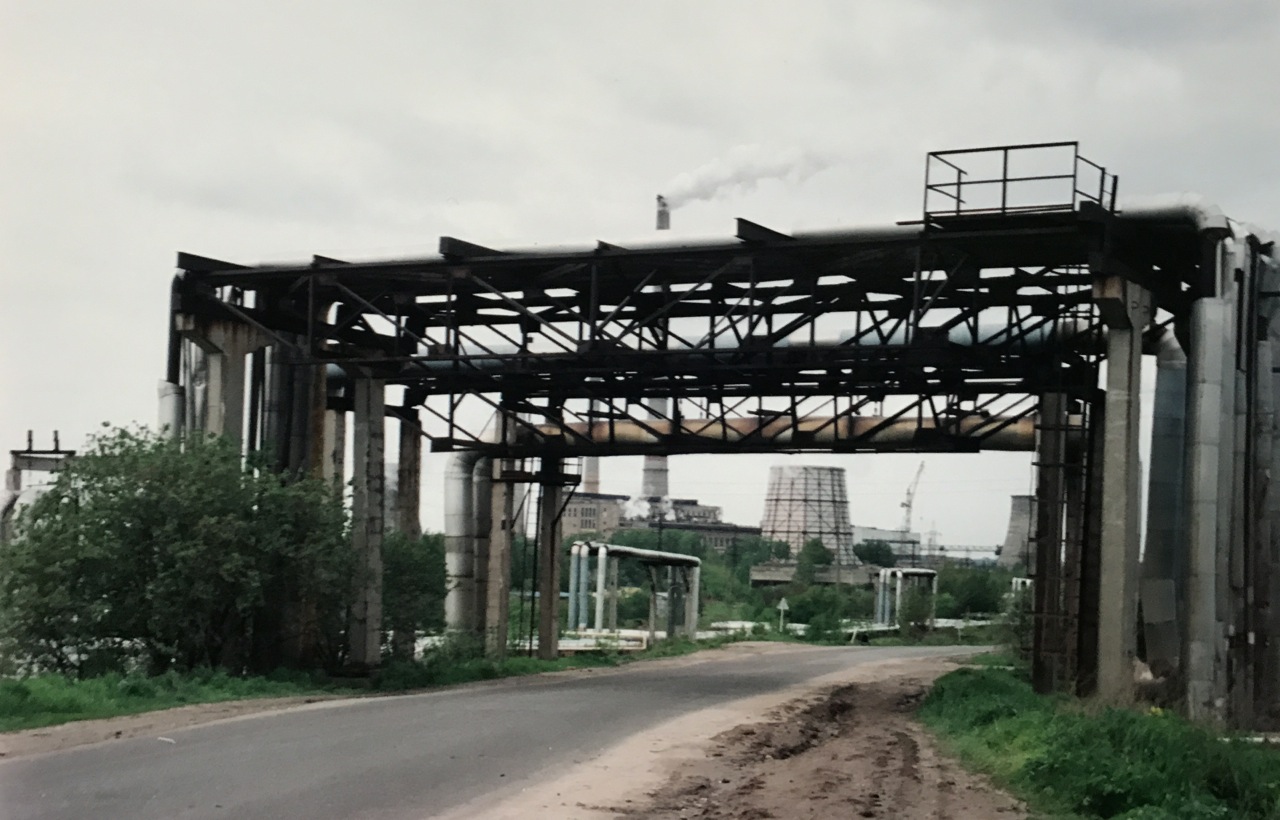
The town entrance is one long factory, Khimvolokno, built to be proud, now tired and run down. The roads are lined with massive pipes. Our hotel, just outside the town, is one of these wild concrete, oblong monuments. Inside surrealistic long corridors like you get in dreams which you are running along and never get to the end, with dim lights and doors passing you by. Reunited with Bob and Victor, we are all very wise after the event. Bob decides he wants to be a General (prompted by the hats for sale in the Hotel).
The Volga project officially begins at 17.00, with the taking of the first samples. We are all finding our roles and feet. Victor holds the safety rope for Sasha gathering samples. I write the sample sheet forms (already avoiding camera carrying work!). Irina is delighted to get started. We all celebrate with vodka and orange in the evening. There is always a reason to drink.
Saturday Tver -> Ostashkov
Morning meetings, Irina translating red herrings, animated talking, no hard facts. We go to blow up a boat and sample near Khimvolokno factory. The boat is provided by the local talent (NGOs) who want to build a green commune without data.
A church and a graveyard – my first local graveyard. Far more colourful than I have ever seen before. Each tomb is enclosed in blue painted iron railings, Russian crosses, adorned with fading photographs of firm strong, serious faces, around the spring flowers. Many died in 1940. Hardly surprising. Yes, Stalin’s terror, but Stalin had some success: he engineered the T-34 tank, the best tank of WW2, he dismantled 1,500 factories and rebuilt them in Siberia, and least we forget he bore the brunt of Nazism “the war was the Soviets finest hour”. But what price?
Irina left us at Tver railway station, bound for Amsterdam. Bob was now in charge, he was the General. A hunger wobbly thrown by Olga is appeased, (her fucking and blinding in Russian is over the top of our English heads). Using his diplomatic skills Sasha suggests to a stubborn Bob he may like to stop at Topjok, “It has many churches,” stammers Sasha. Olga gets food and we get onion-headed churches for Bob to film.
So many old and wonderful buildings deserted, forsaken and falling into the ground. Why forsake these solid beautiful buildings and build again, squat, square breeze block flats? Because they are not centrally heated with running water, replies Bob impatient at my naivety.
The road continues pine and silver birches as far as Ostashkov. Our hotel is unpromising from the outside (square breeze block), but inside is a welcome surprise – people are laughing and enjoying themselves, there is a party atmosphere. Bob, as the General, is invited to dance. Girls in high heal shoes on tree stump legs, men in leather jackets, all unashamed by their crazy dress, shapes and rhythm. We are the 2nd foreigners, EVER, to book here.
Sunday Ostashkov
Crazy run along the grid of Ostashkov roads. I got lost, took my bearing from the lake, not realising it rounded on 3 sides of this town. An hour later I asked a local for a hotel (assuming this to be a reasonably international word – no phrase book in running tracksuit and no memory of the name of the hotel). They did not understand. Tried 2nd tack of red brick industrial chimney stack spotting (I remember one being near by), climbed over fences to get an aerial view to discover 5-6 in the area. Felt helpless without words. Finally struck lucky, backtracking correctly. The run was 2.5 hours!
The local environmentalists, Yuri and Alexander accompanied us throughout the day, (separating Bob and I who were not on good terms). We walked to Klitchen island, from where Bob took off for the Ministry of Defense island. Forested in pine, carpeted with Lilly of the valley (landishy), it is the home for only birds (and one snake almost trodden on). Yuri showed me Kisletza, a white flower and bitter herb eaten locally. He gave me a young pinecone to eat “This is what we ate during the war”, he explained. Early evening nightingale song and sunshine. We must have walked 10km, back through to Ostashkov. Bob and I patched up the morning differences – he offered to come in search of a cemetery with me. An evening meal, with Victor discussing breakfast. Much vodka and orange.
Monday Lake Seliger
Boat trip on Lake Seliger. We are in search of the source of the Volga, which like many sources is much disputed. Some say 17km away, others 70 and others still that it rises in the Lake itself. The latter is what we are backing and hire a boatman with ubiquitous gold teeth and proud displaying smile, to take us to the ‘top’ of the lake. The boatman gives me the wheel of the speed boat – at last I am driving (forbidden in the van because I am a woman), and with great pleasure I put my foot hard on the throttle and speed along.

At the top of Lake Seliger, passed beehive houses, we disembark and climb a hill stopping by a grave made out of a tractor wheel, which describes the death as ‘tragic’. Victor thinks the man was murdered, Bob considered he died by the wheel of his tractor, and I, that he drowned. Victor, our investigator, finds out the next day, his car turned over at this point in the road. At the top of the hill are some Russian trenches and a large shell crater; here was the end of the Russian German line. In fact the Zverda plant on Gorodomelia island, where Bob was filming, was built at the end of the 2ndWW. Here two German rockets were dissected for know-how. We take samples further down. Bob exploded at my slowness, stamping his foot. I cried out “I can do what I want, it’s a free country”,
“No it’s not, it’s Russia!” which dissolved the argument into laughter, Sasha frequently quoting this at later opportunities.
We returned to the Monastery Bob visited yesterday, at Nova Pustyn, which was in Russian post revolution state of dilapidation, and in Russian post glasnost in some attempted state of renovation. Proudly fanning the water front of bright cerulean blue, it’s yellow ochre walls, windows and ornaments outlined in white like a piece of Wedgwood, and onion heads of course. Light green trees lined the causeway, planted by the monks to link to the next island. We climbed the stairs to the bell tower to see the panorama and surrounding Seliger.
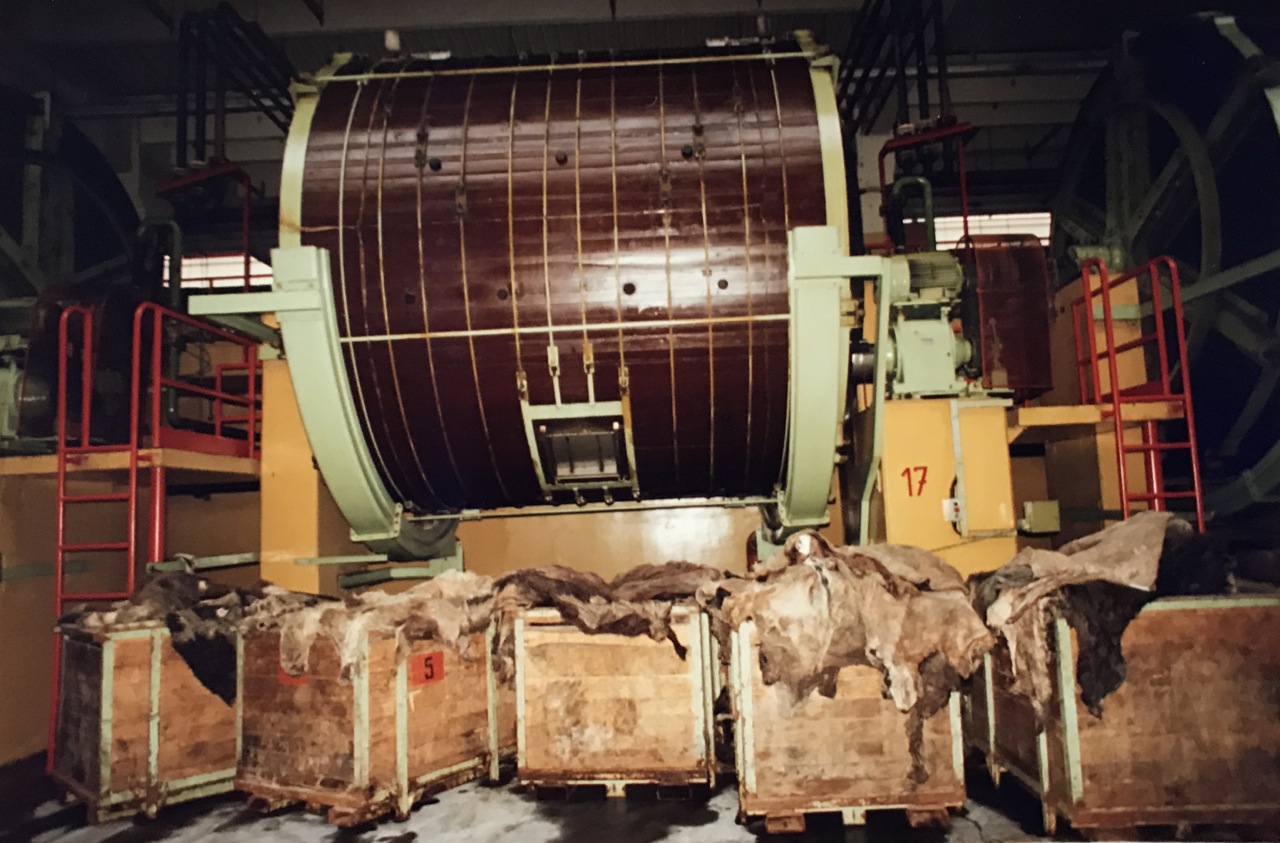
Visited the tanning factory. As the film crew disappeared I found myself alone, walking the inside alleys lined with rows of giant vats – barrels, silent and still, then one or two would start turning. It must have been a km long, each section refining the leather care. Having started at the end, I walked up to the beginning, and saw in the trolleys muddied carcasses recognisable as a cow.
Via the bookshop, where I bought up their stock of Lenin cards, back to the hotel. Bob drives me to the graveyard we had tried to find yesterday. Another long affair, with wrought iron enclosed graves. A magnificent Teutonic central figure of a woman representing Peace.
Back for a Ukrainian singsong with the lads in the van, sad love songs and hard drinking songs. As usual we had something to celebrate – Victor had found two eels. One for scientific analysis and one for eating. The evening ended with a row between Bob and I (loud enough to be overheard by the lads). He walked out of the door shouting ‘You give nothing, you selfish cow’!
Later some reflection. What I took as a deft dance of avoidance, Bob felt was a lack of response, a keeping silent, an uninvolvement.
Tuesday
7.00 sharp start. We arrive at the Kalanin nuclear power plant at Udomlka. Endless tower blocks, harsh, giant and intimidating. The delicate cross hatching of pylons and electrical wires that surrounded the plant were a light relief and very photographic.
Bob, Victor and I went shopping for milk, after an abortive attempt at milking a cow in a near by field. I hasten to add after all radiological results were cleared as clean, measuring 3 becquerel/L, in fact cleaner than German milk sampled by Volodya last year. (The average around Chernobyl was 200 becquerel). I transcribed Beetles songs for Voloyda. We pressed on. The same avenues of pine and biriosa although tree felling was more evident the further east we went. The same gingerbread style houses in the small towns, although the overhang became more accentuated. As Bob reminded me as we arrived in Krasny Holm, these places are in deep snow for the winter months. The summer lasts but 2 months and after that dark wet cold. We are in their small window in which to grow and frantically collect wood and food before the cycle begins again.
We eat – always a priority – in a funky basement bar, surrounded with locals with serious haircuts. Excellent meat and chips for 50p. I stretched my legs walking round a scaffold onion headed tower (photographs for Pip of scaffolding). An unusual war memorial with a positive base relief of a woman carrying a child, and negative base relief soldier 41-45 – a contrast to the more usual macho aggressive hero clothed in machine gun accessories.
In the evening over vodka and orange come more drinking stories: Two men talking, one optimist one pessimist. Optimist says, what a long neck you have – good for drinking vodka, for savouring all that distance the spirit. Pessimist, “Yes and a long way for it to come up”. It is Victor’s birthday tomorrow. “You are as old as you feel,” I say. “I am 25 then!” he replies laughing. We are laughing talking in Russian and English, Volodya consistent in saying nothing in English and understanding everything. I partake of the exchange ‘Why are women so bad at parking cars? Because they are misled as to what is 6 inches” Volodya is the first to laugh. I learn from Olga that Russian uses different words when talking factually and affectionately.
Wednesday Chereopovets
Unremarkable journey, reading the Russian history post 1917. Occasionally looking out at another passing statue of Lenin. All village main streets are called Lenin street. Understanding the name, helps me begin unravel some Russian Cyrillic.
Chereopovets, gloomy, red brick Victorian buildings (a contrast to the tower blocks), and rain. We celebrate Victor’s birthday with bloody chicken, mushroom pate and Russian champagne. Talk of communism, Olga becoming passionate and negative. Everyone declared what they wanted out of their life: Olga to make the world a better place, and to be liked by many people; Victor to have his friends near him; Sasha to have his dacha in the country, and his friends. Vodka in the kitchen afterwards – only Victor sleeping in the car prevented us from going to Volodya’s nest, the van.
Thursday Chereopovets
Out of the 7 hours of the working day, 3 of them are spent shaking bottles, working with Sasha, who has an even dependable cheerfulness. All this for science. We’re in the front of the Mercedes van parked in a residential square, watching people at different times of day come and go. Men returning for lunch, women returning with their children, old people taking a once round the block stroll. No one took a second look at our spectacle: a Caribbean hair braided woman shaking bottles listening to Beetles songs, in a Mercedes van all day long.
We finished at 10. Volodya had cooked tasty (unbloody) chicken and had vodka to welcome us. Bob woke from his second sleep that day ate then demanded talk on work. We are all dog-tired. Victor asks about breakfast in the middle of Bob’s work, effectively diffusing the tension. I carry on drinking with the lads, exchanging drinking proverbs: Hair of the Dog is Trobie Goriat, when your stomach is on fire, you need to put out the fire. “Let the cow eat grass and live in Ukraine”, a drinking salute.
Friday ->Yaroslavl
After Ukrainian breakfast of 3 friend eggs (the Ukrainians add chicken and potato thick soup), we set off at 11.00 and again at 2.30 from Chereopovets. Some way down we discovered the road by the lake was still being made, and we came unstuck on sand. I sleep most of the way (declining hair of the dog). Yaroslavl, like Chereopovets, very unpromising in the rain, but we are happy see at last the Volga again. Our affection for this river grows. After all the lakes Mother Volga had grown her girth which has augmented with the rain and spring tides. The Ukrainians are happy here; Yaroslavl was foundered by Yaroslavl the wise, Prince of Kiev, who rose to the occasion and killed a bear the locals set upon him, with an axe, and thereafter won undying respect. Our hotel, the Yubileynaya, overlooks the River Kotorosl, a tributary of the Volga.
Saturday Yaroslavl
Casing the joint. A plethora of pipes visited, all discharging into the Volga. Olga, Andrez and I are sent out to find a map, and I escaped the Church of the Prophet Elijah. My first icons, surprisingly humanistic, albeit heavily restored. Took in the Kremlin monastery, once again climbed the bell tower, to be eye line with the onion heads.
Sunday Yaroslavl
Sampling of the Volga around Yaroslavl. Up at 6.30, boat yard by 7.30, all smoothly arranged by Victor. However, the boat engine still not turning over by 9.30 so abort to plan b. We drive to Rybinsk (means town of fish), where the lake is controlled by two great damns, giving hydro-electric power generated. Bob furious that Volodya parked so far from our restaurant. A cigarette appeased, and Bob took up smoking again. Back to plan a. the boat working, but it breaks down after 3-4 samples taken. Engine taken apart, 3 times, laid out on the boat floor, we paddled to shore. Too right I need a vodka!

Greenpeace gathered in the evening. Irina returns, (I’ve missed her). GP Moscow arrived in a selection of battered cars. Sasha Knorre (GP CIS), Ivan Blokov (GP Moscow) a couple of Russian side kicks and Vladinir Ouduevenko from Kiev to collect the samples. Russian is spoken and it is difficult to know exactly what is going on. There is, naturally, drinking. The group divides, hiving off the decision makers while us riffraff drink and chew the cud. The politics revolves around Olga. I watch Olga and Andrez making love with words and hands, lounged on the bed shared by 6 of us, seemingly unaware of their importance in this charade. Both are rake thin, an easy foil to our wholesome Ukrainians, with an abundance of proverbs extolling the virtues of eating well. My weakness is often remarked on as if I am tired due to my thin weight. Andrez repeats the few English words he knows “Olga is beautiful!” They laugh as they are falling.
Sasha, he of the rolling eyes, and I discuss climbing in the Caucasus, then the plight of Russia.
‘Russia is like the Volga, fantastic at the beginning and a disaster at the end.’ I ask about why the locals appear not to be interested in us.
‘They are thinking about where they get their next bread from, to be concerned about a passing tourist. Their poverty is enormous’, he says. I think back to Africa. My first introduction to Russia was there, meeting Ole and Margarita – their words over Tusker beer resonating here. I remember their inquisitiveness, their thirst for knowledge.
“Russia was ‘first world’ not so long ago when we held our heads high, and knew the world shock when the bear spoke. We have waited long enough”, Sasha said. “Our fathers, grandfathers all have suffered many perished. They worked to make this country better, and now we are promised the reward, we are hungry for it.”
Tuesday Yaroslavl -> Zarvolzhsk -> Kineshma
Enormous breakfast fried eggs, cheese, and bread. Zarvolzhsk is deserted except for bird song and dandelionn. They are waiting a delivery of oil. We take a ferry – because it is there – across the Volga to Kinishma. Volodya gathers local information. Women walk in high-heeled shoes across uneven, un-tarmac roads, skirting puddles and rubble: how – and why – they do it? As usual chicken and potatoes for dinner.
Wednesday
An early run around the town taking in the market, at 7.30am the place seems full of vodka wobbling people. Everywhere is drink. Gorbachov, I gather, tried to cure this national sickness by limiting the purchase of vodka per person. As one might predict, it only encouraged home brewing.
Wednesday Kineshma -> Nizhny Novgorod
People pick the plethora of dandelions to decorate their homes. Biriosa gives way to populars. Beehive houses, which I finally understand are dachas. Grass becomes greener, and a meadows full of cornflowers. Nizhny Novgorod timber houses line the main street.

Thursday Nizhny Novgorod
For once I am early to bed leaving the boys to their vodka and song. I cannot accommodate Bobs eating without a care in the world for those around participating in the feast, tucking in as soon as his plate is in front of him, stuffing down the food. Oh dear, Rachel, how to look above this small things. However provocative Bob is, he does shake me and wake me up.
Today he allowed me to take 2 photographs – the highlight of the day! I am not on good form, perhaps mid-term blues. I know I would not have missed this for the world. Usual regrets: smoking too much, not pushing myself on my morning run and not learning enough Russian. Start again tomorrow.
Friday
Better day, with semi-role as photographer again, recording the events of team b, sediment sampling while Bob ‘movied’ with team a. After another flare up in the morning between Bob and I (over not leaving our hotel room key with reception) and serious left footedness, as it is called by the Russians – getting out of bed with the left foot), we changed hotels to the left bank of Oka, for a more spacious self contained apartment, where we have our own kitchen, where we can cook chicken to our hearts content, all for 10,000R a night, in comparison to 60,000 for nothing. And parquet floors!
After team A had departed (ie Bob), Victor declared time for breakfast. In the cafe, near the giant gesturing Lenin, I watch a grey skinned man, alone, with as little distance as possible between spoon and mouth, never looking up. Successful sampling until the end, when we needed the boat. All blown up and ready to go, we realised we had not packed the paddles. Sasha and Volodya started to improvise with plastic bottles and wood, until I volunteered that there was a boat up the road we had passed with paddles, – perhaps we could borrow them. Victor stripped down to red underpants – they had to be red! Bob is convinced they are all putting on weight courtesy of Greenpeace, but the argument does not stand countering with the money Victor has saved us with accommodation.
Notes from Chenobyl
People: Kruchov – father of soviet atom
Beria formed the Ministry of Medium Machine Building
Slavsky, the energetic chief engineer, Dollezal, the 2nd engineer.
Brukhanov – head of Chernobyl
Dyatlov/Formin – engineers
Reactors:
VVER – pressurised pressure reactors
RBMK boiled water reactor, using same graphite moderator, and uranium fuel with water coolant.
Commissioned in 1983
23 April 1984 “The system of democratic centralisation had taught them all that the all-knowing and all-powerful Central Committee could make decisions only”
Monday 28 an alarm went off in a Swedish nuclear factory, which provoked the Russian’s to go public, and announce on TV. It was the 7th news item. Other 3 reactors were kept going, due to demand from the grid
Vodka, an immediate medicine, was given free on prescription. Evacuation turned down until May 1, when 50,000 evacuated. Later they bombed reactor with sand bags full of lead and boron.
Saturday
A day of consolidation, extracting in the van with Sasha, cheerful Sasha, and bringing notes up to date.
In the evening, Bob refused to open the door to our room, so I got the master from the landlady. He wanted to talk, I had little to say. “You give me nothing. You treat me like a child… You are more physical with Irena than me.’ While I see my silence and evasion are frustrating, I am frozen in action. In the morning, he declared he wanted to strangle me(!).
Sunday
It was the day of the planned picnic, not boding well with snow melting to rain encompassing NN. We all slept in. For the Boys and Irina it was a day of eating. Bob, Zhenya and I ventured into Russia for a motor tour. Flat lands drawn with lines of birosa. An epitaph to a revolution, a hollow gutted church bare (beautiful) red brick, just the shell left and home to pigeons.
Borsch soup (my first) cooked by Irina, and marinated veal cooked by Bob, “Ah this is good…very tasty…” says Bob.
Monday
A record of 4 industries sampled, plus water treatment plants. An adventure for Bob. He was caught taking photographs of a railway and bridge (forbidden) and interrogated by the KGB (while reading Sol’s Golag epic). Sasha and I were left waiting 3 hours by the side of the road, eventually made our way back by public transport. Today I heard the song of the local nightingale, melodious over the most polluted water yet.
Tuesday NN -> Cheboksary 215 km
There is a change in this massive country. We have travelled 4,500 km so far. The roads lined with biriosa have given way to flat lands in Chereopovets. We are in a town of poplar tree-lined streets. Our hotel bathroom includes a boot-shine apparatus, the waitresses in their 50’s flared shirts were being trained to oblige and attend. I feel oddly sad to arrive at something vaguely familiar and European.
My mind turns much on Bob and I. I am treading water, finding it difficult to look in the eyes. Today he is scornful, more confident, perhaps bolstered by his KGB experience. It is true what he said, I have given very little.
Wednesday Chebuksary
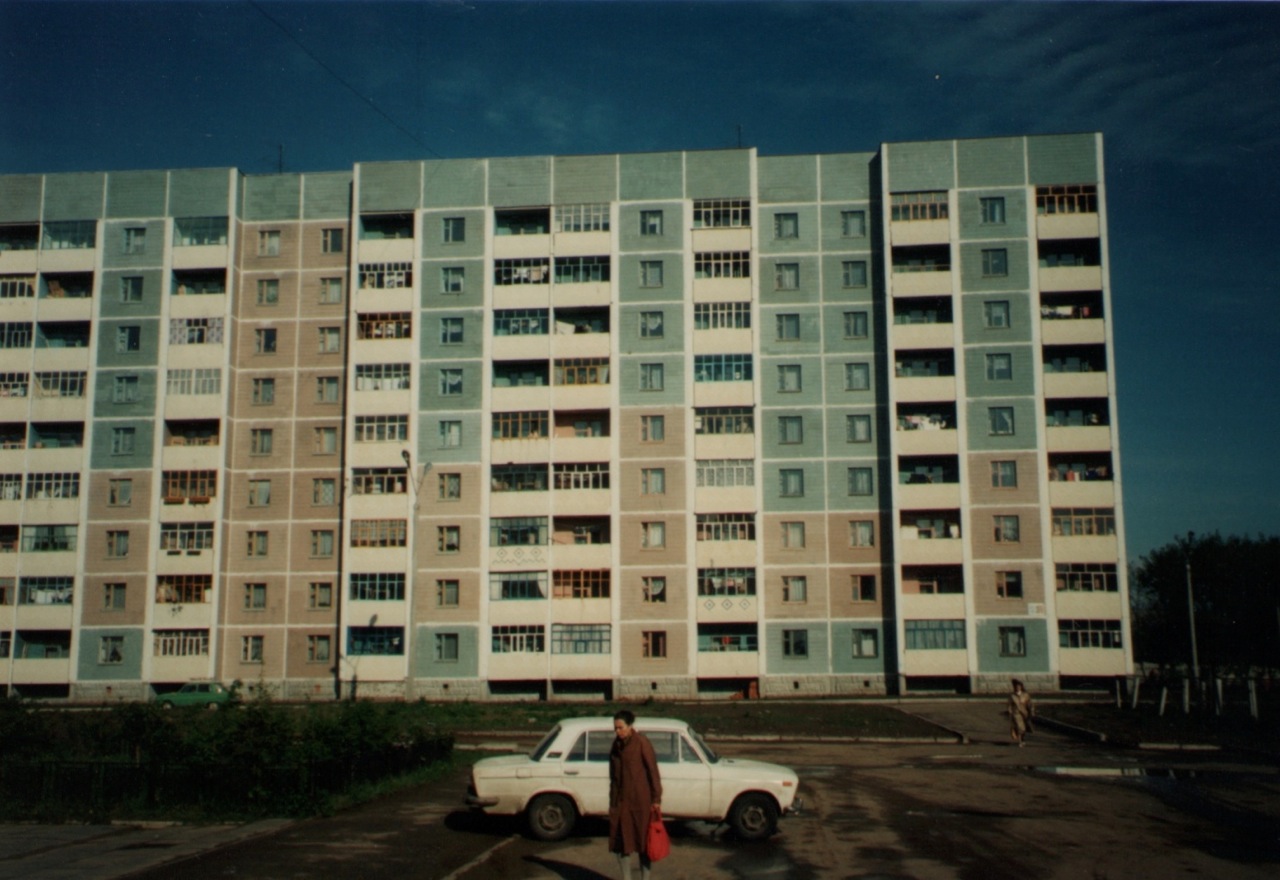
We tour our last smoke stack, sample our last piece of polluted Volga. Chimprom is one of the biggest enterprises in Russia, former manufacturer of nuclear weapons, and of course chlorine.
The plant and surrounding town of Novochebuksark was built in 1901, and like Pyrpet near Chernobyl, it was a ‘favoured’ town, given extra provisions, people’s wages were more than average. They built this industrial town from scratch, displacing an old village, leaving only the graveyard which I find on a mound near the stacks, poetic juxtaposition. A platoon of pylons, a phallus of chimneys, a plethora of pipes – I’ve always liked p words. Lilac and Lilly of the valley is sold by thick women on the market, women cement the pavements, paint the windows. Young women in their healed shoes tip towing through the mud of factory yards. Dachas surround the factory, people tilling ground directly under the pylons, the four base girders forming the parameter of the patch.
In the evening over some Spanish red wine, Bob and I talk. It was a good talk, we should have done this earlier.
Friday
We prepare to leave Chebuksary, bye bye plants. A huge welcome back feast prepared by the boys, Victor and Sasha, who in our absence had shaken for 360 hours. (Victor has broken my record of 180 hours). They also took the opportunity to sleep (no Bob alarm call). Of course the feast a chicken based, washed down with vodka!
Saturday Chebuksary -> Vyzniky
Despite the fact that all scientific staff were up at 8.00am, we did not depart Chebuksary until 5.00pm. Victor and I did the last extractions, followed by a series of tasks. As Bob observes it is single file sequential, one job has to be completed before the next person can begin the next. Bob and I shopped for Zills, the Ukrainians shopped at the White Goods Show – and extra-ordinary bazaar of fridge’s and freezers and music systems – everything electric, that they could buy with their GP dollars.
The finding of the perfect camping site was long. It was a complicated and exacting process, that required not only consensus, (vans had to be safe, not too near mud or cows, etc), but also required water – we had after all been working on the Volga.
We found it through a pine forest beside a large lake. Not only do we have wood for burning, water for swimming and cooking, but also plenty of mosquitoes. We all put on the all in one scientific suits, covering all parts of our naked flesh, looking like Russian cosmoneaughts of old. Only Zhenya, the Russian, remained unaffected.
Bob: “Everybody’s telling me what do to, and I know what do to, I am always right”.
I escaped. As the sun set, I leapt on a boat with Zhenya, and we rowed out into the huge lake. Water so still and mirror like, rushes turning golden in the light and bird song and frog choruses crazy. It was the here and now, not captured on a piece of film. With the binoculars we watched a foray of Krachka, grey and white and elegant birds, diving and turning round their nests in the long grasses, then skimming the water drinking or fly catching.

After we returned I went out to the pontoon listening to the cocophoney of frogs and an occasional deep Vwip.We all (except Bob) set out for a midnight swim. All naked (although I in my English modesty kept my pants on) and freezing but not so cold when you got in, falling from the boat into black treacle, silent water. It was exhilarating. Back to the fire to warm our feet, back to the vodka to warm our insides.
In the morning a photographic session with Bob, Zhenya rowing. He quotes his mother “Don’t keep a dog and bark yourself”.
We had a final swim. This time I was not so English, and easily dive naked into the lake. I am not ashamed of my body, feeling it warm to the weak sun. Two years ago I would never had the nerve to have done this, fearful of water and imaginative water snakes.
We leave for Suzdale, aptly described by Martin Walker as ‘one vast museum and tourist complex, high minded if somewhat funless Soviet version of Disney land’. It was Sunday and mostly closed, we were the only wanderers around the desolate and scaffolded monasteries. But we did see inside one of the 30 churches – to Bobs chagrin, I stayed 10 minutes for an orthodox service, covering my head with my jumper. Serving priests had exotic long hair. Thick tighted women frenetically kissed the icons. Young lads (altar boys?) nonchalantly walked in, kissed quickly and disappeared behind and icon clad door. I left as the incense began.
Meanwhile the Ukrainians, true to form, had found food as we toured.
Moscow at 11.00pm. Eat and bed. I do not like Moscow, or being back amongst ‘civilisation’
Monday Moscow
Despite face, arms and legs blistered with mosquito bits, I feel on good form. After one month of being molly cuddled by translating Ukrainians and decisions being made by Bob, I realise I must pull myself up by my bootstraps. My own adventure begins now. I am to St Petersburg!
Having lost the room key last night, I lose my ticket and passport. Bob, sensing my vulnerability, warms to me, and lends me some dollars.
At GP HQ, Dima, the retiring head of GP Moscow, is lying prostrate on the sofa, being administered to by Levi jeaned employees. The conference table is bought to him, all are gathered for the debriefing. Sasha Knoor, Ivan Blokov, Zhenya, Olga, Bob, Irina, Sasha, Victor, Volodya. It is a stormy meeting. But there is one resolution carried: Olga is let go. Olga no longer of the Volga.
While the Ukrainians and Bob prepare to leave for Ukraine, I am given into the hands of Zhenya who will escort me to his home town of St Petersburg that evening. Bob has softened, and declares he will miss me. I too, begin to miss him.
I kill time in the afternoon, by making 2 treks to the American Express building, once without traveller’s cheques once with. Longing to get out of Moscow. We wait at Ivan’s for the 1.00 train. It is an pukka train, departing on time, comfortable, smooth. Only in the morning a slight hiccup – the toilets ran out of water. I love sleeping on trains!
Tuesday St Petersburg
St Petersburg captivates me. It is like no other city. Clear air, clean wind, elegant classical Italianate buildings, tree-lined streets, soft light pastel colours. Gone are the ridiculous onion heads and harsh intimidating square buildings of Moscow. The people look at you, eyes smiling, as if not afraid. Here at last a free city, with a soul and a history of blood, revolution and writing.
I’d said to Zhenya that I wanted to find a hotel, but he said he had room. It turned out not to be a spare room, and I slept in his daughters bed (who was at present in the country with Tania’s mother), separated from the sofa bed of the sitting room used by Zhenya and Tania, by a bookcase. I felt awkward. In the morning I escaped as early as I could to give them space. They had not seen each other for 2 weeks!
Reluctantly I felt I must do the Hermitage – the sunshine persuaded me otherwise. It is not disappointing. Wildly confusing, I attack these 3 buildings in one, with a swift reconnaissance of all rooms and floors. My mind blown by recognising so many paintings whose reproductions were familiar to me in slides in my history of art A level with Mrs Howard. Mattise Dancers and early Picasso’s. I sit and draw the outline of the dancers which is so elegant. My drawing is not bad for one who has not drawn these 10 years.
Wednesday St Petersburg Tikhvin Cemetery
A cemetery (naturally). The Tikhvin, within the popular shaded grounds of Alexander Nevsky Monastery. A mass is in progress, I lit a candle. The graves are impressive, with the same Moscow like sculptured heads and bodies of local dignitaries, writers and engineers.
In a light world-is-my-oyster mood, I sauntered towards the metro. A gang of kids came at me from different directions. They grabbed at my rucksack. With a bravado that surprised me, I shouted and kicked, cursing them with all the swear words that came spontaneously into my head. In slow motion, I was aware that people around looked and walked on. I swore and kicked the more. As quickly as they came, they disappeared in different directions. People looked at me in silence. When I looked at them, they lowered their heads and walked on. Suddenly I hatted St Petersburg. What had they taken? Nothing except they had robbed me of my innocence. Then another feeling, my anger was healthy, I was becoming Russian, this would not destroy St Petersburg for me. It had after all a positive outcome. Now I would be more attentive.
Indeed St Petersburg’s glory was resurrected that evening, as I look my first walk into the white night with Zhenya. We started at 11 with two beers in his inside pockets. We began with politics. Since January there was no local parliament, the old one dissolved by the mayor. “Because he is absolutely crazy” This was Zhenya’s standard exposition to explain local politics: “They are all crazy”. His conversations begin and end with ‘This is very interesting’. When I observed that there were so many beautiful women in St Petersburg” he smiled and said “Thank you”.
We walked passed the Winter Palace, bathed in a glorious light the likes of which I had never seen. There was a feeling of magic. We crossed a bridge, resting to drink our beer, and reluctantly returned at 3 in the morning, still light in the sky.
Thursday Smolenskoye Cemetery
Once more I get up early, leaving the two naked bodies asleep in the sofa-bed and found my way to Smolenskoye Cemetery, provoked by an article read in Leningrad News picked up yesterday in the German bar, describing a ‘new vandalism’. Oh that Leslie were here, I think. I am the only one here, feel prick of nervousness, and stick to the main paths but still get lost. It is a Lutheran cemetery and one of the largest and oldest non-orthodox of the city. Until the C20th one of the main burial grounds for ethic Germans.
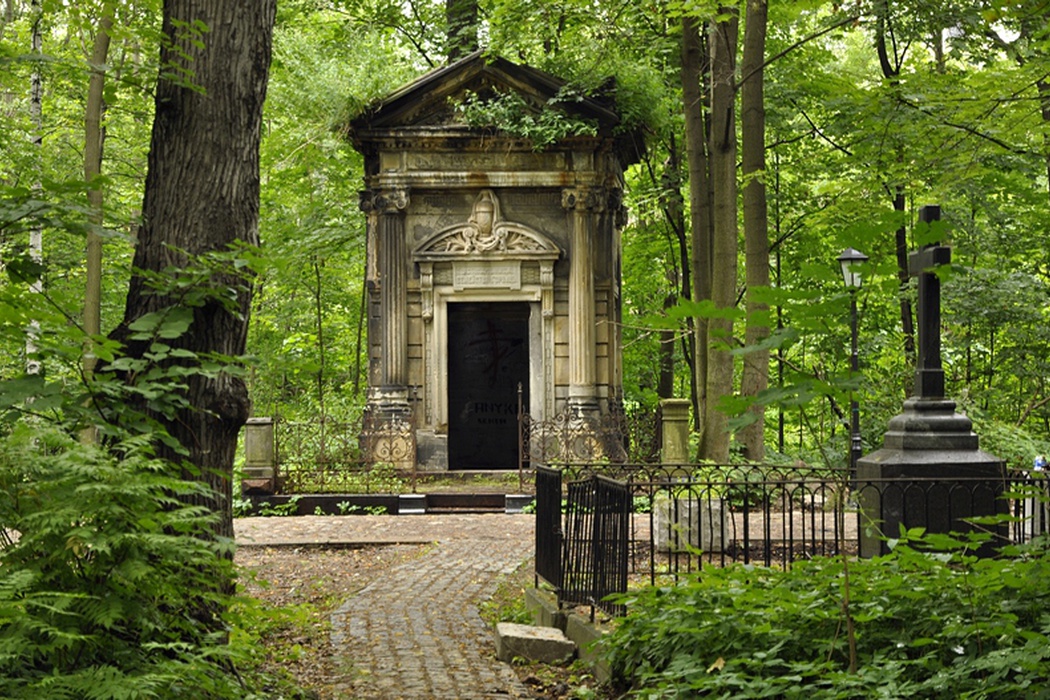
The weather has changed, bright hot sun giving way to cold and grey clouds. I think of this city ice-bound for a third of the year. My diet of cigarettes and chocolate is telling.
After shopping for bush legs and red wine with Tania, I find the Pushkin house which is a memorial to his death with a portrait of his assassin, a French poncer called Dantess, who killed him in a duel. Puskin’s waistcoat and gloves, the chamber where his coffin lay and before that himself, taking 2 days to die. Painful.
Museum of Revolution is dominated by a printing press and all that it produced. This city loves its words. Newspapers are displayed for the public to read on bus stops – a good idea.
Home to sausage and potatoes and a silent woman, who suddenly turns out to speak English. A drinking game commences. Tania snatching gulps of red wine when Zhenya’s back is turned. Zhenya is not happy, and I begin to see why – Tania cannot take her drink, is the English expression.
‘I want to walk’, I say as the escaper. The silent woman comes with me. Outside we hail a taxi – I can feel all is not how it seems. We travel first south, then east then north. I abandon thinking how far I will have to walk back and retaining my bearings. Down Nevskij Prospect, passed Puskin’s house to the Summer Gardens, over Troiskij Bridge past Peter and Paul gleaming in the silver winter sun, back across the pastel green of the Winter Palace.
“There is something I must do” she said. “I must pay some money.”
We cross north again, driving further and further. We stop by a block of flats and go inside. The transaction is done. It is midnight. A man in a singlet is sitting on a bed, the woman in dressing gown ironing, counts the money on the ironing board. She puts a coat over her dressing gown, and comes out with us.
“I want to show you the apartment of our people,” my guide says. We knock on the door of an adjacent apartment. It becomes even more bizarre. The door opens. There are two people, an old man and woman, I am introduced and shown around. On the left is a room stacked shoulder high in old newspaper, this is where the old man sleeps
“He fought in the great war” she tells me. The man does not look at me. I can hear the scuttling of mice. I am shown the kitchen with basin, but no outlet for the plug, except the floor. The old man unsettles me. The whole thing unsettles me and I walk outside, leaving them to talk. My guide joins me. I feel angry.
“Why have you bought me here. You have taken me round the beautiful white night of St Petersburg, you have shown me things I have marvelled at in such light and now you bring me here, wake up these people and parade them like animals in a zoo. What is it all for?”
She shrugged her shoulders
“Because I wanted you to see both parts of St Petersburg” she said and smiled. We get in the taxi, that seems to be contented to wait for our whim, stopping to buy cigarettes and juice. She is taking me back. On the way we stop by a church that is special to her. An old man is burning wood. She drops me at the entrance to Zhenya’s.
I find Zhenya looking at a Charles Bronson movie.
“Ah you are safe. I have been looking for you”.
I tell him briefly of our adventure.
“Yes she is crazy” Everyone is crazy with Zhenya. Tania is snoring the sleep of drink.
“How is she? I asked;
“I hope well” Zhenya shrugged.
Saturday St Petersburg to Sverty island
Mosquitoes again, buzzing round, eating flesh under trousers. This place would be paradise without them. But what are a few mosquitoes to the people of St Petersburg, they are a mere itch in their hard lives.
We depart for “our island” as Zhenya calls it, encompassing me into ‘our’.
Of course everything is delayed. Friday to Saturday, 8.00 am to 12.30. We are joined by a couple, friends of Zhenya’s, and drive in a beat up Toyota with bald wheels and little suspension, us 3 girls in the back (of course), driving on old tarmac pot-holed roads.
After some hours and close to the Finnish boarder, we pull up by the side of the lake. Here they get out some canoes from a hut, dust them down and put in the water. I am sailing with Zhenya. It is fabulous, cutting the clear water with the spade of the ore. Stopping sometimes to listen to birds or watch a landscape. We draw our canoes to the bank and set up camp on Sverty island, a long tail like promontory, about 5 meters wide. Wild flowers carpet the floor otherwise layered with pine needles, Lilly of the valley, white and blue forget-me-nots, and a white starflower that I am told is poisonous.
We cook tinned soup and potatoes. A little excursion to a hill of rocks thickly covered in moss, which would make a perfect bed. But we too have to make a mattress of reeds, I am sleeping with Zhenya and Tania, Tania strategically in the middle, separating us!
Sunday Sverty island
The dynamics are sometimes strange. Andrez strong and silent. His girlfriend, manly and eager to prove her strength. Tania with her long painted red nails, and heavy blusher delicately holding the fishing rod, and good at catching fish. At mid-day we go off canoeing and fishing, Andrez dragging a line behind, catching nothing, I in the middle, Zhenya rowing. We stop to bath. Off with our clothes, into the water – I am the first! Afterwards we lie a short while on the hot rocks, our wet bodies for a short while unattractive to mosquitoes.
As we return a wind gets up which blows the buggers away. I read Tolstoy the Death of Ivan Ilyivch, pacing up and down to dissuade any settling.
For the evening meal I deviate from the Russian boiled luncheon meat by inviting them to partake of my Chinese spiced soup mix. It is enjoyed only by Tania, despite Andrez’s efforts for he is clearly reluctant to refuse any food. I take a photograph of his face curled up in discomfort. I must of course eat their food as well, and pretending to walk about avoiding mosquitoes, I find a bush to gently tip it into.
We pack up. Tying the canoes together to form a catamaran (same word in Russian), we row back through wind tunnels and gentle sun. With impeccable timing, it begins to rain as we disembark on land. The car journey back is in rain, but I sleep which blocks out the discomfort of the unstrung back seat.
Monday St Petersburg Piskariovskoye
Adapting easily to Petersburg hours, I get up at 10.30, tiptoeing passed the bed, and buy eggs for breakfast and roses for Tania.
I must go to Piskariovskoye, on the on the Avenue of the Unvanquished, dedicated mostly to the victims of the Siege of Leningrad. I tried persuading Zhenya not to come and put me in a taxi, but he was adamant to protect. He did not want to go to such a place, he saw no point in such recent history to old neo-classical buildings, or an old graveyard – these he could understand.
We picked up a taxi in the usual manner.
It was like nothing I have ever seen before. Like Russia itself, like the towering tower blocks, like the giant statues of Lenin, like the endless avenues of biriosa, it was incomprehensibly large. The first thing that took my surprise was the music: Russian funereal march music Tchaikovsky, Rakhmaninov, Shostakovish. It seemed to come from the trees, until I saw a speaker hidden in the branches. It pervaded the entire cemetery. ‘Like an echo of the chimes of Khatyn and the bells of Buchenvald’ my booklet described.
Walking down the main avenue, broad and sombre. I begin to feel the scale. Like in a dream, I never seem to get closer to the colossal outstretched arms of the Motherland at the top. Left and right are oblong raised mounds of grass, 10m x 40m, each grave has a slab of granite bearing an oak-leaf and the date: 1941, 1942, 1943. The mass graves. The hammer and sickle is carved on the graves of city residents, the five-pointed star on the graves of soldiers. Altogether there are 186 common graves, in which almost half a million people lie in rest. Yes, this is going to be a place of numbers. Numbers, a way for us to begin to conceptualise the scale of this local war. More people died in Leningrad during the 900 days siege that the entire WW2 Allied forces altogether.
Finally reaching the Motherland statue, (begging to be photographed) a woman, romantically dressed in classical long dress, leaning slightly forward, holding in front of her an open wreath of laurel leaves, as if presenting it to you as you approach. Behind and to the side are various bass relief’s, like stations of the cross, depicting images from the war, soldiers holding guns aloft, women carrying dead to be buried, people morning, strong faces looking out.
Walking down avenues, touching the surface of the 28 hectares, I came to an area of mass graves with biriosa trees, studded with photographs and dates. Small details amongst such anonymity.
Exhausted, I made my way back. At the entrance, a simple yet profound exhibition of half a dozen photographs in black and white, bare photographs, bare facts. One of the frozen road over Lake Ladikaj, which provided the road for food and communication. 361,309 tonnes of food passed along this road. A girls page of a diary is displayed, Zhenya translates for me: “Sasha, my brother died; Grandma died, mama died” finally last page “There is only me now”.
The task is done, the place I wanted to visit has been visited.
I give Tania and Zhenya a silk shirt each and $50. They are delighted, and immediately put on their new clothes.
Tuesday Moscow
I awake in excellent spirits. We – Zhenya has returned to Moscow with me – are too early to do anything, go anywhere, so we have a stand-up breakfast on the steps watching the Muscovites come and go to work. Definitely not Waterloo. No suits. One in every 10 is drinking a breakfast of beer – the beer stall is the only stall open. Women struggling with packages tied haphazardly with old string. We move outside the station, and admire the neighbouring Yaroslavl station built by Fyodor Schechtel 1902-4, a handsome curved and tiled art nouveau building. Still nervous of taking photographs in this country (I envy Bob his carefree spirit) I take a hasty snap of an everyday Moscow tableau, a man dead drunk, body strewn on the parapet wall, trousers half down, shit on his thin legs. It is all too far away for me to comprehend. We move a third time to Pushkin square, where I find a bench in the sunshine, and put my legs up for 30 winks. Zhenya is nervous, sits and reads. When I awake, across the road I see Macdonald’s. When Bob first mentioned Macdonald’s to me, I scoffed, saying I would never eat Macdonald’s in Russia, but live and eat local food. Now it was like a friendly face, clearly signposted, way in, way out, with pictures you could point to, describing what you wanted, and above all, white tables outside to sit at and watch the city go round. Zhenya shocked at the price, as I treat him to a big Mac and wonderful coffee – all for R12,000.
Greenpeace office. I strip off by filthy jeans, and dress in a little black number to salute the sun and go in search of ART!
Tretyakov Gallery. I want to see in particular the icon Our Lady of Vladimir. My guidebook describes this gallery as quintessentially Russian, one of the world’s great galleries, symbol of Russian nationalist and cultural revival C19th. It was disappointing. Undergoing re-organisation, Our Lady of Vlad. was absent as were most of the other major Russian paintings. Two redeeming features however: the stunning icon of the prophet Elijah, first given to me (reproduction) 20 years ago by Father Eric Doyle. There it was in all its red splendour, eyes close together, angry and strong, looking directly at you, stylised lines around, very little restoration; the other surprise was another icon, the famous Andrey Rublev’s Trinity. Large and naked – no glass to protect it. It was rediscovered in 1917. Calming pastel colours, no doubt faded with the years, I followed the many triangles within the painting, the three angles, their eye direction, their feet and their hands. As I followed, women and men came in front to prayed before it. Trying to understand the Russians through these icons, ‘little windows to eternity’, I read the story of the theoretical gallery: Tretyakov bean collecting paintings of urban life giving a truthful yet humorous portrayal of the character as well as morals and manners of the Russian people. He built his museum at a time when admission to the Hermitage in St Petersburg was granted exclusively to visitors in full dress or tail coats and the titles of the pictures were given only in French. Tretyakev established a gallery of Russian democratic art, opened for the public by 1890.
I moved onto the other Tretyakov gallery, foundered by the brother Sergi, who donated his collection of Dutch old masters and French C19th to the Pushkin Gallery. A wonderful Salvador Rosa “Old Coquette”, of an elderly woman having her toilet and make up done by her maid, her full image from the mirror reflection revealing crinkled breasts, fattening neck, but eyes still young and lively albeit sad, as she sees her own spectacle. I go in search of Cranach, and find two. “Results of Jealousy” 1530, typical of the Elder. The smooth S shaped body, detail of hair on the men’s feet, interest in foreshortening. Very clear spider signature between the date. And then on to light and life – the French know how to do it. What do the untravelled Russians make of these gay social pictures? Gauguin’s Self-Portrait, a well-known Toulouse Latrec, Yvette Guilbert. Again Picasso’s Blue period draws me, and in particular Young Acrobat on a ball, with the unformed body of youth, contrasting with the sculptured solid stone like man in the foreground. Another well known surprise, Monet’s Dejeuner sur l’herbe – never noticed the silver birches before – and two splendid Rouen Cathedral paintings.
Returned to Greenpeace, to find Zhenya had left for Saratov to collect computer equipment from Olga no longer of the Volga. Ivan gave me the keys to his flat, and I made my way on the metro. A thoroughly enjoyable evening, exploring this new area, drinking beer and nosing around. A bachelor flat.
Wednesday
I don’t want to see another icon! Using Martin Walker’s excellent guidebook I did the boulevard walk, the Inner Boulevard Ring. Starting at Kropotkinskya Metro station, down Gogal Boulevard, the gentry area, where the Tretyakovs and Checkov lived. Most of the roads have been renamed since Mr Walker wrote his book, and I have the common Russian dilemma of buildings knocked down. The finest honey at the market of Tsventi Boulevard could not be tasted – the area was being redeveloped the market raised to the ground. Passing the HQ of TASS and Investia I located Nory Mir offices, the heart of Republican literary revolt. First in the forefront of Khrushcevs thaw a generation ago, by publishing Solzhenitsyn and more recently, in Gorbachovs time, publishing Orwells 1984. As I took a photograph, some men asked if I was CIA.
Completing the circuit, down Kirov Street passing a mock Chinese teashop, feeling hungry on the look out for some food, I do my usual of following people into unmarked doorways. I found myself in a gun and fishing tackle shop, the gun counter crowded. The guns looked old fashioned, as seen on Black and White TV films. On the next counter, bread was being sold, I pointed and paid.
As one must, the Kremlin. I paid for the whole caboodle, R20,000 – R2,000 for the grounds would have been sufficient. Boring fairy tale castles, multiple onion heads and over restored icons inside. This was when I got my fill of icon’s.
On the metro back were white clear skinned women, with a thin silver chain around their neck and bright orange red lipstick on their perfect mouths, the ladies of Moscow. Designer dark glasses with the quality control sticker still on the side. Hairy legs! I imagine them as more comfortable in fur hats and mufflers with high leather boots.
Back to the bachelor flat and a spot of housekeeping. With some gumption (found in the Irish hard currency shop) I cleaned the layers off the bath, and mould off bath tiles.
Thursday Moscow Anatoli
Meeting Anatoli was like opening a window into a Moscow life . He was a friend and contact of David, from the British Computer Society. He could have been a Tolstoy character, moving frenetically physically and mentally, alert bird eyes.
I was late for the meeting at the Bibliotics. Once out of the metro, I could not find the ‘Stalin building’ as instructed. Passers by, as usual uninterested. Starting with businessmen, thinking business means education, I found one of those beautiful young pale faced women who spoke English. By the time I got directions I was late with a 30 minute walk in front of me. Anatoli was cross. ‘You are late. I gave you good instructions.’ Followed by “Today is crazy. This morning my cat pissed on my lazer printer.”
Yes he had a beard and looked tired – the description of himself he gave over the telephone. I’d arrived at the first CD ROM conference in Moscow. It was a low key affair, John McBride (from On-Line Computer Systems) at last spoke in English with translator. How they put the customer first, was just plain boring. White skinned red lipped librarians whispered together in front of me – they were so far removed from the mousy English conference participants. Outside Anatoli and I found our first easy denominator, we smoke a cigarette, and were joined by a manufacturer of CD ROM who told me his factory used to develop military systems, and with a small modification has enabled him to make CD ROMs for civilian use. We returned to Anatoli’s apartment, immediately reminiscent of Paris.
He lives of course, with his cat. His mother lives upstairs and comes down to clean for him. In the kitchen as Anatoli prepared coffee, as we talk broadly of the changes in Russia.
“I hated, no, despised the past regime” he said. “but somehow now I have a nostalgia for it. Why? Because the grapevine worked, now nothing works. In the past, you organised a concert. You told your friends about it, and they told their friends, and the concert hall was packed. Now you put up posters, take advertisement out in newspapers. Strangers come, in dribs and drabs. Then I read, I ate any book that came in my direction. They were precious. Now I have little time to read, travelling too much I suppose. And now with every book I could ever want to read at my disposal, and no desire to read it.” I spoke to him of Africa, where a newspaper was savoured for a week or more.
We sat down by his computer, which he grumbled was slow, and he showed me a translating programme, recognising the full ambiguity of language, until he finally said, “Rachel you are right, I am tired, I need to rest”
We arranged to meet on Monday, as his mother arrived to do the housework.
Returned to GP flat and cooked up wholesome chicken broth. When Ivan returned we drank vodka and discussed politics.
Friday Moscow
A hopelessly lethargic day, but I did manage to visit two monasteries.
Once again, paid Rubbles for old rope as I found myself in a room packed with austere icons at the Andronikov monastery, where Andrey Rublev lived and worked and is buried somewhere in the grounds. The central small cathedral was, however, old (1420) and beautiful, the oldest surviving example of stone built architecture in Moscow. The sun came out from behind dark clouds, showing good Romanesque lines. Took photograph and smoked a cigarette.
The Cathedral of Virgin of Smolensk reminded me of the first cathedral I went into in Yaroslavl, of St Elijah. Like St Elijah it was painted from ceiling to floor with thank god, unrestored tempera narrative paintings, from old and new testament. Ground to waist level was trompe l’oeil of hanging material around the walls, and Florentine-like flower decoration around the arches of overlapping foliage. It would make a good wallpaper or fabric design.
Saturday Moscow
I am at the Bolshoi theatre – seat for $15, not quite at the top but on the same level as the great chandeliers. It is the Queen of Spades, music by the man whose tomb I was sitting opposite not so long ago in Petersburg. The opera is conventional, stifled and over applauded. Only the baritone of the Countess, who died very early in the plot, held my attention. The rest like the painting exhibition I saw today, is blatantly chauvinistic. But there is style. Everybody has dressed up, no jeans. Handsome proud young men with shoulder length hair, more white skinned women in flared black velvet dresses with red gloves. They are so damnably proud. Eager to point out what is wrong, and they are right and opposed to being challenged. In a conversation with Ivan about Solzhenitsyn who had returned to Russia after 20 years in America, I asked “What news of him Ivan? Where is he on his pilgrimage now?”
“Who knows. He is no longer news here. He will just arrive. People are not interested in his thoughts on how to better a country he does no longer know. He made many mistakes in his last book, The Golag Arpeligo”
So Solzhenitsyn is wrong, he made mistakes, he said 20 million people died in the golags, and probably nearer 6 million tied. So the Golags existed, and what about the heart of his story, not the story of numbers, but the story of how people died and survived.
Sunday Moscow
The Cosmonaught park, once a pean to Soviet industry, is how the giant neo-classical buildings divided into 1,000’s of private enterprise kiosks selling electrical goods and kids toys. One good photograph of two tramps watching the world go by on a park bench, vodka eyes, bitten and swollen ankles. Despite the peeling paint, and general run down feeling, the place is alive with people, young and old.
I felt low when I got back. It hadn’t been a particularly difficult day, but I felt tired with the fight, to get on the metro, to find a place. Ivan arrived, we drank some vodka and talked in English, which quietened my mood.
Zhenya returned from Saratov with Tania. They had a car accident, all very dramatic, and we drink vodka for life. After vodka, bush legs and much discussion on the role of women in Russian society, Ivan asks me what I actually do in London for my work. I am unexpectedly overcome with emotion. It is the first question he has asked me about myself. I had just wanted someone to say, who are you in an inquisitive way. Zhenya telephoned Tania. She has been drinking and now curses. Suddenly our little soiree is disrupted. The dispute with Zhenya continues, the phone rings, it is slammed down. But I am happy. I had found the cause of my blues.
Monday Moscow Anatoli
Today I had my celebrated meeting with Anatoli. Of course, I was late, to my annoyance. “I’m only 30 minutes late” was my opening gambit. He was still tired. His cat was still endangered. We talked about his illness. Was it an ulcer? We looked up the word in a dictionary. Yes probably. He must eat. But we didn’t eat, and went to meet one of his prodigy companies.
What does Anatoli actually do for a living? As far as I could ever understand, he is a Russian theorist and linguist with some entrepreneurial flair and is immensely proud of being the first owner of a 286 in the USSR. He formed a network of scientific humanity people to develop computing in general and out of this melting pot grew Paragraph and Informatics, both involved in developing Russian language dictionaries and fonts. Anatoli had been the inspirer and financial backer, although he was pretty hazy about the latter and more probably he knew how to tap into financial backers. On the way back we passed through his club, which of course was terribly famous, the place where Nicholas II fell and broke his leg, and where Ronald Reagan was entertained. ‘You are honoured to walk on the same turf as Ronald Reagan’ he said with straight face. I was neither rich or famous.
“Should I fulfil my strategy of sending my daughter first to Oxford then the Sorbonne?” he asked. “And this is where Kasperov lives, he is in our group you know. And here Breshneiv had his flat designed, with his apartment 4 meters higher than the rest. All of us are equal, but some of us more equal than others.”
We returned to his flat to eat, and he immediately regretted his decision, lamenting it’s condition. The saga of his cleaning lady continued. But he retracted his regret as he produced an excellent meal of steak, my first bloody tender steak in two months, served with pasta and mushroom sauce. He continued the discussion about his daughter.
‘She was staying with a French family They shown her a television, and video, ‘they both work; they said, and icing on the cake, introduced her to a computer, as if she were a surf from Bosnia! Naturally she told them more about computers that they ever knew, and forwarded them a list of people she wished to contact in Paris, and they were amazed by the list of famous people she knew. Those ignorant French’.
He asked about the Volga, and managed to elicit my life story from me. He, on the other hand was evasive if I asked him a question. His eyes however, were kind and intelligent.
I brightened up when he talked about language. He told me of a Russian expression used by his daughter, “I do not want to go aboard yet, I want her to know about the stove”. The stove was the heart of the contemporary Russian material house. He described the parts of the house, and how the bath area was not so clean for that was where you entered and got clean, began with the letter B as so most of the words that had to do with dirt.
Tuesday Moscow Kiev
Slight hiccup on the romantic train journey from Moscow to Kiev. I was stopped at Russian/Ukrainian boarder due to a lack of visa. I had been told I could get a visa on the boarder. Stage 1, get all my luggage off the train, and watch it depart. I am told by fierce gesticulation that I am to get the next train back to Moscow. Stage 2, sat in run down police station reading Tolstoy story the Cossacks. Stage 3, they find a young lad who speaks a splattering of English. He examines my air ticket, and says, fine, you can get a visa in Kiev, now they know I intend leaving their country. Stage 4, waiting for the next train to Kiev. Managed to find the best chocolates ever and ate two boxes.
My new train carriage is with some Russian God Squad, bible reading people, clean and very disapproving of me smoking a cigarette.
At Kiev I am met by strong Victor, who carries my rucksack to Irina, where a feast is prepared.
Wednesday Kiev
Irina is having her cyst dressed by her doctor husband. I am sleeping in Olga’s bed, once again partitioned off from the marital bed.
Getting a visa is not straight forward. Sometimes the Visa office closes in the afternoon, sometimes in the morning, today it was closed all day.
A neighbour arrived in the evening, a film producer, and we see his film, the Imitator, about a man who imitates the politicians and is used by them to aid their fall and rise. They all end up in lunatic asylums!
Thursday
The visa challenge continues. There is an unusual sense of achievement in this country when you actually find the place you are looking for. The visa place was open, in fact bursting with people, white, black, sitting, standing, and one woman serving everyone. Loud shouting Ukrainian voices. I took 20 minutes to get the correct form, all in Cyrillic Russian. A woman who spoke English, advised me that I could do no more than take the form home with me, and get my friends to fill it out.
Next to get a Ukrainian air ticket. The computer was down, go to another building. It is 2 km away. The computer is still down, I am told by the painted girl behind the glass, who is trying her best. A man speaking English and I laugh and discuss the general matter of what do to, wait or not wait, when the computer comes on-line. Success, the ticket is booked!
In the evening read through the Volga notes with Irena. There are far too many of Bob’s tantrums. The evening mixed with Bulgarian red wine and brandy, the unbeatable Ukrainian salad, all grown from their Dacha, looking at old photographs of Victors and Irina’s marriage.
Friday Kiev
I did not get a visa, a. it was closed, and b. I as told I needed to go first to the British Consulate. I did not go to the bank, I did not go for a run. I did eat chocolate and a full egg breakfast. My thighs and bottom are increasing, my lungs collapsing, but still I love this country and feel very content. Today we accomplished 75% – all annexes to the report have been named and catalogued. Bob has orchestrated me a job in Greenpeace.
Saturday Kiev
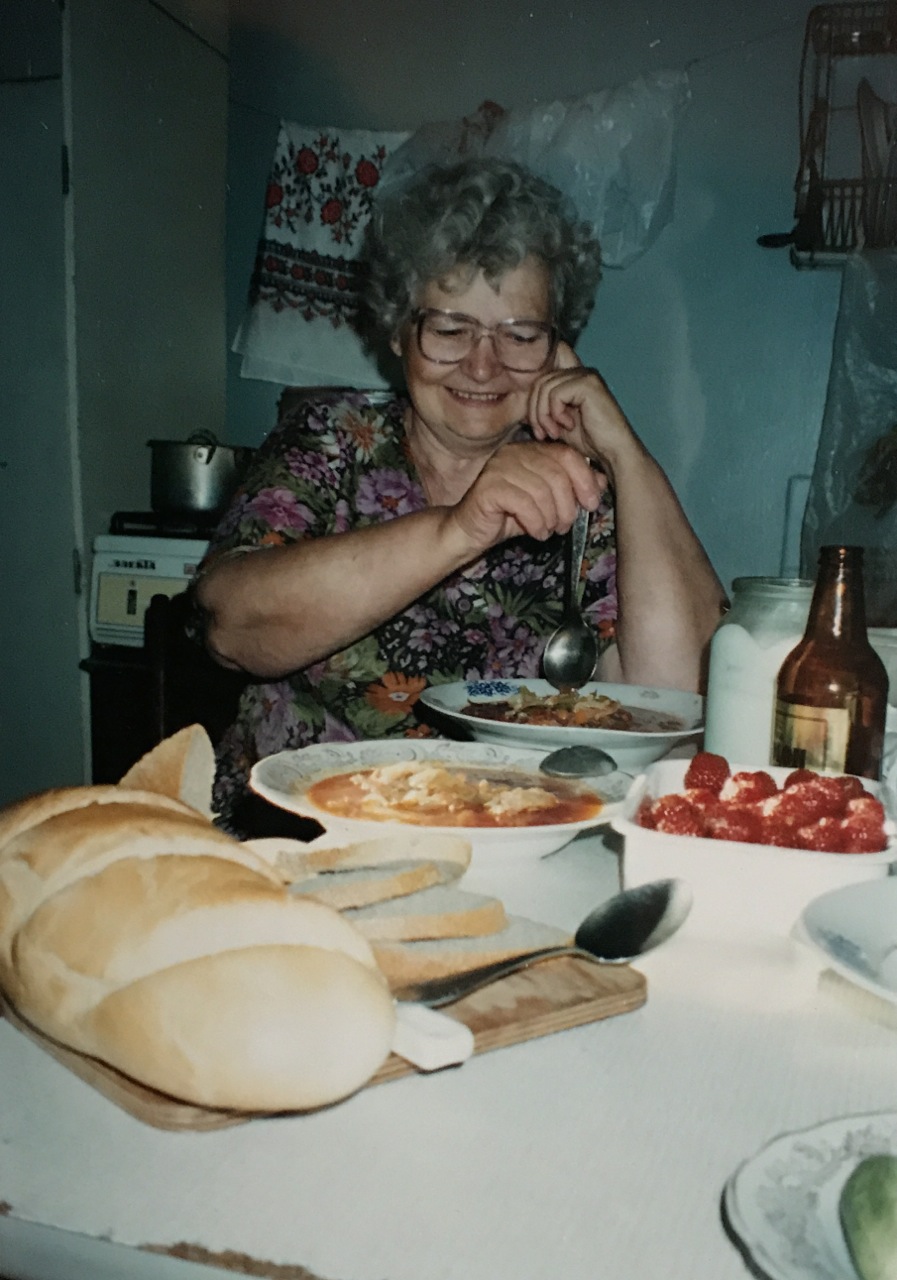
I have moved apartments, and now live with Irina’s mother. It is an interesting situation, I speak 20 words of Russian and no German, and she 20 words of German and no English. This is not the biggest problem. No the most difficult problem is copping with the amount of food I must consume here. Tonight I sat down to 3 underdone eggs in Russian style left to get cold, coriander, tomato Salo, cheese, cold meet, tea and strawberry jam. I must always eat plenty of bread, to make me strong (she thumped her big breast to indicate strength!).
Sunday
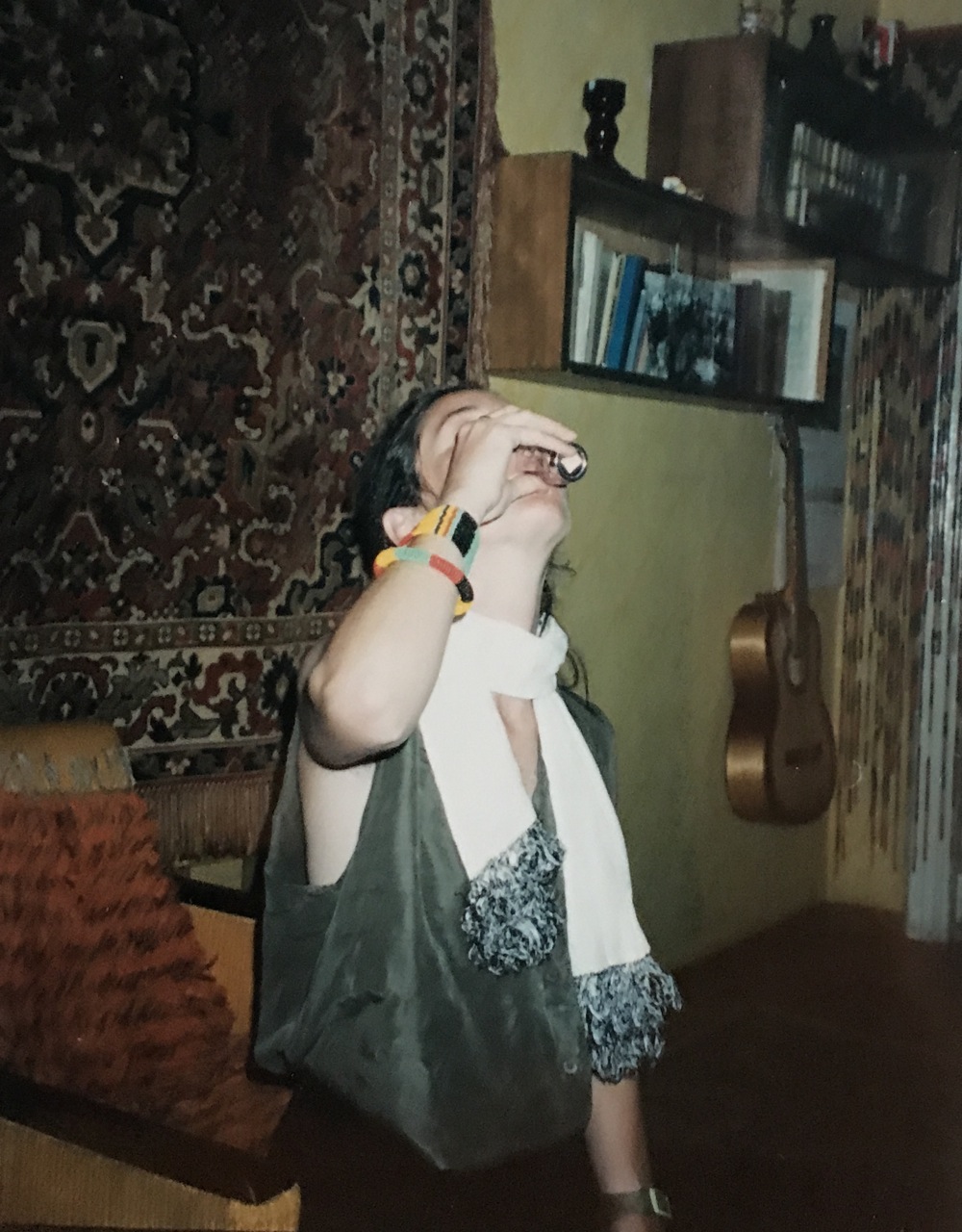
Spent a pleasant leisurely day with Irina getting the report complete, while waiting for Victor. Lunch up the road, drinking champagne, talking about Irina’s father, his sudden and unexpected death, she with tears in her eyes. Victor by now was 4 hours late. When he finally arrived, an argument ensued and he walked out again. Irina and I took off for Victors singing friends. Wine, vodka, Ukrainian songs. Irina taught me the merits of draining Vodka in one gulp, this way you got less drunk, as the spirit was not absorbed in dribs and drabs down your oesophagus (but you still have the same quantity in your stomach, I think). Ukrainian joke: Man stopped at Ukrainian customs. “Do you have any drugs?” “Yes” “What?” “Sallo, I just so enjoy it”.
Monday
We welcomed back Olga from the Crimea along with Victors parents, a large and forceful mother and diminutive father. We all took off for a bath in the nearby river. She stood proud and full in a bikini, tummy overlapping her trunks, legs bronzed and bruised and scratched, full to bursting bosoms. God I love this Russian unselfconsciousness.
Monday
It was a disastrous day, but somehow ended ok. British Consulate at 9.00, where a black man in the queue said, ask here, it is your home after all. Spoke to the Vice Console himself, who directed me to completely the wrong place, who directed me back to my first place, which by the time I returned was closed for the afternoon.
Photocopied all the maps and sent the final report to Bob.
Wondered aground the streets. Managed to negotiate a tram home – my first Ukrainian tram, sardines in a tin. Irina’s mother is not well. This morning she made me take her blood pressure. I had no idea what I was doing, and she soon cottoned on to that. This evening she rests. Victor comes laden with chesnok and flowers from the Dacha. I make some lemon tea for Irina’s mother and lie in bed with her, her large arms pulling me to the cushion of her bosom, while together we watch a French comedy, which I find hilarious, waking up Irina’s sleeping mother with my laughter.
Tuesday
What a farce. I am 10th in the queue of people at 11.00. After two hours, I manage to hand my passport in to collect tomorrow, then I must pay my dollars, somewhere else, but of course it is lunch now, and they may open at 2.00. I join the queue of people waiting, curling up some stairs. One and half-hours latter I hand in my $50 dollar bill. She cannot change it. She has change, but she cannot use it. It is the law. “How is it” a Swiss man exclaimed, “they manage to create a Gogolesque situation so easily?”
Wednesday
I got tired today of finding places and of not understanding or being able to shout back. I cannot change my $50 dollar bill, I cannot post my letters. A lady sits down on a park bench beside me to eat an ice cream. She gets out a piece of paper to sit on. Her bottom overlaps the A3 paper. Her healed shoes wobble with her weight. Above all else, I like returning to Irina’s mother in the evening and her outstretched arms. Tonight borsch soup, she talking away. TV once again, curled up beside her, watched Trading Places, she snoring gently beside me. She said, and I understood every Russian word. “It is better that we are two than I am one”.
I did manage to see a cemetery, called Baikova. It was as always satisfying to find somewhere off the beaten tracks, full of bird song and wild flowers. The same Russian grave methodology perhaps more exaggerated interest in etching faces in the stone. One I remember of a woman and her daughter, the woman born the same year as me, 1957, but looked 50 years old.
Thursday/Friday
Wow! Hair of the dog required today. Visa accomplished! After one week of trying every day. Yesterday they told me to come back at 2.00 today, but I chanced it and passed by at 11.30. The cunning buggers had opened in the morning. In the queue up the spiral stairs (that I had come to know so well), I had an chance meeting with an American Rabbi, Arial Stone, and we passed a very pleasant couple of hours, exchanging Ukrainian observations, starting of course with this absurd satire. She was paying for a visa to go to Poland, to visit Auschwitz. Why not? she said, it is relatively close. Now with a translator beside me, I understood more of the Gogolesqueness of this situation. Nearing the top a black man could be heard asking each person, “Excuse me, I just want to ask one question”, and he would pass on to the next. As he neared us, it was more difficult to get a simple yes, we were near our own chance, and they might after all close for lunch soon. When he finally made it to the cashier, to our utter amazement his question was: “Do you have a bank account I could pay my visa money into?” The question was so absurd, the whole stair well of people queuing laughed. When she said no, he asked “Why not?”, and the reply came from further down the stairs “That’s two questions”.
My turn came to bend down and pay the lady behind bars (paying in money in Russia always involves discomfort). I handed over by $13, but to my horror she returned my form saying something in Russian. This could have been a disaster, but for the Rabbi beside me, who explained all she wanted was 20 Coupons. 20 Coupons! For that I would have had to return tomorrow!
Bound by crazy delight at our success, we decided to celebrate and have a beer. She introduced me to a hard currency bar, with air conditioning and waitress service! Then on to purchase some red caviar. We exchanged email addresses and said our goodbyes. She was a breath of fresh air, a decompression chamber for me, to me, an excellent listener to whom I let pour out all my questions.
Back at the Kiev lab Sasha and Irina were meeting a dead-line. Victor arrived and we all squashed into the GP Van and headed off for our final picnic.
It was a picnic by Sashas Dacha, on the banks of the Dneipa. Immediately, naturally, we all took off all our clothes and swam in the cool clear water. So it may be polluted, as GP Ukraine keeps telling us, but who cares, it is sweet now! We came back to shore to pick up glasses of champagne, which we drank semi submerged, one hand holding the glass the other a cigarette. The men collected the wood and made the fire; Volodya’s son collected willow, stripped it of its bark and speared the marinated meat, tomatoes, onions and peppers that us women had cut. We ate standing up, moving to avoid the mosquitoes. We drank champagne, bottle upon bottle, followed by red wine, ending (of course) with Vodka. We took a final swim as the bright red sun set over this huge river, even Volodya O took off his plastic hand and came in this time. Later as Irina and her boys played volleyball, I drank a beer with Volodya O, and asked him how he lost his hand (why not?):
“I lost it when I was 14 years old. It was an old German mine. It exploded in my hand. But I tell you it has never stopped me doing anything I want to do, in fact with it I have been able to do more”. He has been working with Irina two years as one of her boys, and when I asked her how he lost his hand she replied: “I have never asked him. If he wants to tell me, he will”.
One of Victor’s jokes: How do you fish with a cucumber? First you get a large quantity of vodka and empty it into the river. They you caste out your rod with cucumber on the end as bait. The fish, like us, will soon be gasping for the cucumber.”
The evening ended strangely. We all pilled into the van, and drove back to Volodya P’s small flat. Viola his wife apologised for its size “We are moving soon”, she explained. Irina telephoned her mother, saying to me after she put the phone down, “I told my mum that we would be staying the night here”. I felt furious. I wanted to go back to those big bosoms that waited for me, I wanted to do as I said I would, I had let her down. I would now have to drink more, and I did not want to. I took a walk. They came running after me.
“What’s the problem?”
“Can I not take a walk?” I said irritably.
“No” he answered in his hesitating stammer, hearing my anger and trying to be firm.”NNNNo you cannot walk here. I..I..It is not safe”.
I stomped inside, and began reading a Ukrainian newspaper I had picked up. Irina talked in her calm unhurried way. Sasha gave me a teasing look
“Rachel, Rachel”.
Viola presented me with a gift of painted wooden boxes. I embraced her, I was softening. Victor began to sing. I love watching Victor sing. His face takes on a melodious beauty and innocence, as his strong high voice sings Ukrainian drinking songs. Volodya put on the TV. My anger attempted to rise again, (I was not here to watch TV), but it was an old Beetles concert, and it bought us full circle, with memories of listening to the endless Beetles tape in the van on the way up to Russia, of teaching Volodya English. Before long I was singing along to Hey Jude, and between singing and dancing is a thin line, soon we were all at it, a little Russian rave.
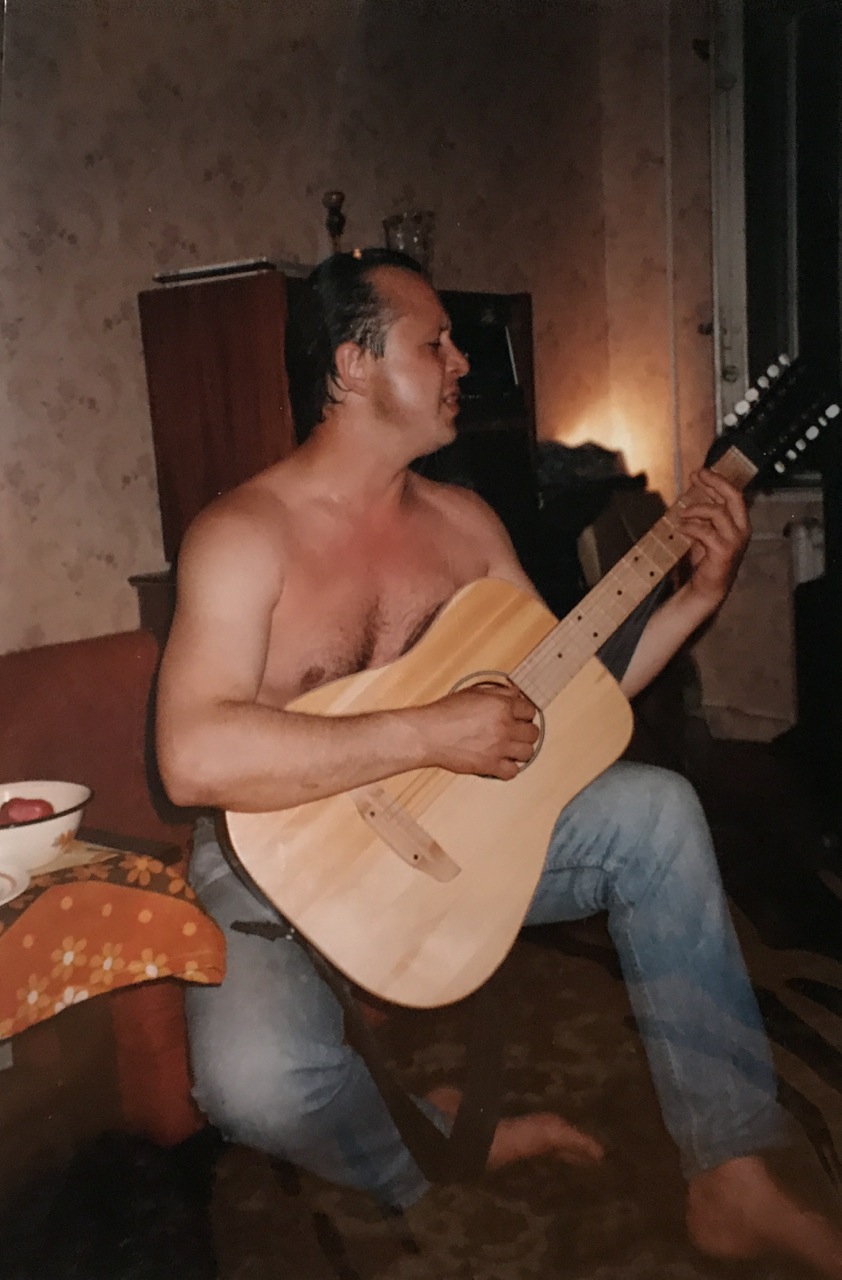

I took out all my Caribbean plats. It was the end of an era, and I danced and I sang. Irina knocking over glasses of brandy, I swinging my long hair. Somehow with burning lungs and stomachs we went to bed. They give me the only bed in the house, while all 6 of them slept on the floor.
Volodya’s breakfast greets the day: omelette and salo.
How mad, after all these years of complex about various parts of my body, ashamed of my mothers legs (no calves), flat feet, undistinguished face, now at the age of 37 I am for the first time both contented with my lot, and unconcerned by it. Ah Mother Russia, you have put a mirror up to my little life, woken me up, shaken me around, and shown me a river.

 Kalikellett
My friend Sara made these comments. She didn’t know me then, or Bob or any of these people. As we said afterwards, it is what is not said that also describes.
Wow! That was some read…..and so different from what I maybe expected. My impressions/surprise discoveries:
Your long lasting fascination with cemetries
Your knowledge of art history
Bob; so early on and already so difficult, not sympathetic at all in the reading.
The booze: so much of it all the time, it seems so obvious from this vantage point that it could so easily become a problem, or maybe for some, already was.
A diet of chocolate and fags
The difficulty and discomfort, hostility even, that you meet with such equanimity along the way
The ease with which you make friends or find a way to function productively with so many, often very different and difficult, people
The seeming sympathetic relationship you have with Zhenya that sounds so much easier than those days with Bob who bullies and yet became your great love
Your easy beauty and your unawareness of it, or confidence in it
How your own needs are rarely met, or inquired of, and how often you accept that, how unentitled you seem to feel
Irena’s mother’s welcoming bosom 💓