Beginnings
Michael asked me to come to Australia with him in his kitchen. Fresh back from Texas, and with tooth ache, he extended this invitation, unexpected, unperturbed by Yuka who was with me, in a disarming straight forward way.
For the last few months we’d been walking then working together on Tuesdays, clearing up Tamsyn’s rich life on paper which of course was more than either of us imagined it to be. In this process, although I am mostly found wanting in comparison to Tamsyn, I notice that I share her enjoyment of recording, of writing up adventures. Sadly I do not have her gift of sketching, which illustrated her diaries throughout their adventures together.
Prelude – Michael to Heathrow, Texas
After reading Checkov’s the Seagull, after a shot of vodka, we exited the friendly intimacy of our play reading group and warmth of Janet’s sitting room, to my Fiat 500 for the journey from Halesworth to Heathrow, where on the M25 we met flurries of snow.
By 10pm we were seated in the Fine Dining restaurant of the Sofitel (La Belle Epoque) having rejected the option of Thai Chicken Curry at the other place, and so we began satiating (satisfying to the full) our epicurean adventure. Venison, Guinea fowl, but most memorable of all was the unexpected gift of Bread and Beef Dripping. Back in fashion, this was the food of my childhood, when every fridge had 3 basins of beef, lamb and pork fat to cook with, before olive oil. All washed down with Australian wine – naturally.
Not for the first time, nor the last, Michael appeased our extravagance with
‘It will be my last time, so let’s enjoy it.’
In the news, Dyson, a Brexitier, was moving his UK business to Singapore.
We took a night cap in the bar, where an Indian called Jesus (from Goa i’d guessed) entertained us with some card tricks.
Virginia’s story
I’d forgotten Virginia was bought up in Australia, near Sydney. Her mother and father emigrated out to Australia with Virginia, aged 6 and her brother, where her father became a mining engineer. He both made and lost his fortune there. Once lost, Virginia’s mothers family paid for their daughter and children to return to the home country, but left her father to find his own passage, which he did after 3 years. He died a few years later.
‘It is an ancient land’, she said to me, which jolted me for until then my vision of Australia was limited to it’s more prosaic recent history, of colonialisation, of being a land of blow in’s like America. ‘You will feel it’s ancient quality’ she said, ‘when you step on the red earth’.
Virgina was 16 when she returned, and found re-entry difficult, awkward fitting into formulaic, tame, and class prejudice of Surrey after the wildness of Australia.
Apart from Virgina, my only experience of Australia was through Patrick White, Voss, and The Tree of Man, which I must have stumbled upon, and they stayed with me. Bob of course, wanted to film in Arnham land, having filmed Kangaroos back in the 1970’s. Bill his friend who ran a gallery in Sydney.
Halesworth Heathrow Singapore Melbourne
I made two fundamental mistakes. I took an unnessary handbag and still too much luggage. Here’s the rule. Pack, unpack take out half, repack. No need to buy books at Heathrow.
Back amongst the transnational travellers, I realise not for the first time, I will never be that cool, one case on wheels, light camel cardigan, sensible shoes, elegant and unflustered. I have an habitual rucksack, a jacket with 5 pockets which I am frequently searching forgetting which I’d occupied and a handbag I do not need.
Bohemian Rhapsody / Colette / The Children’s Act
Singapore – a four hour stop over, in which I got my feet massaged, and bought a larger rucksack in which to put my ridiculous handbag. Many Indian’s boarded the plane from Singapore to Melbourne, and our plan’s captain sounds Indian. I cross the date line, travelling counter to the sun. Sun rise over Adelaide.
In between films, I collected the random rag bag of jigsaw pieces that existed in my mind of Australia. The Ashes. Yvonne Goolagong (was she an Aborigine? There’s a story there). Reading Patrick White (Vos, The Tree of Man, the Vivisector), Fosters beer. Corks on hats. Down under, water turning the other way. My uncle Richard’s flight to Darwin in 1938. Bob’s films of Kangaroo’s and his collection of Aborigine paintings. Bruce Chitin’s Songlines. Nevil Shut, A Town like Alice/The Beach. The massacre of Australian’s at Gallipoli. Miriam Rothchild’s introduction of rabbit flees to Oz. Clive James. The Dig here tree. Spiders (Black Widow) and snakes. Ayres Rock.
Peter Conrad’s short story in Faber
‘Australia’s founding narrative is about rejection, and is not America’s aspiration…. An imperial anxiety of not being noticed. Do we exist? Even Darwin was keen to leave, feeling Australia too isolated, needy and inadequate. Conrad is scathing of Chatwin, who he describes as the collector of countries and ideas.
Melbourne
There are clouds above Melbourne. That’s not what I’ve packed for.
‘Are you going to declare those?’ asked an Australian woman beside me of my snack of nuts. ‘Just tell them, they’ll say yes, but its not worth the fine. Oh yes, Australia is strict on bio security.’
Michael was there of course, waiting at the airport, and off we go immediately into the hire car, off and out of Melbourne. He had a plan, and what a brilliant plan it turned out to be. We drove an hour south east of the city up into the Dangenongs mountain range, and specifically to William Rickets Sanctuary. Recommended by his brothers son, the sanctuary could not have been a more apposite and fitting place to start. Set in a forest of trees, although all foreign to me, I felt at home in this place. I walked out on the Australian earth not on city concrete roads or pavements. I heard those bizarre sounds from birds, the extraordinary, hilarious laugh of the Kookaburra for the first time. I felt the air, smelt the scent of earth and eucalyptus, saw those great trees.


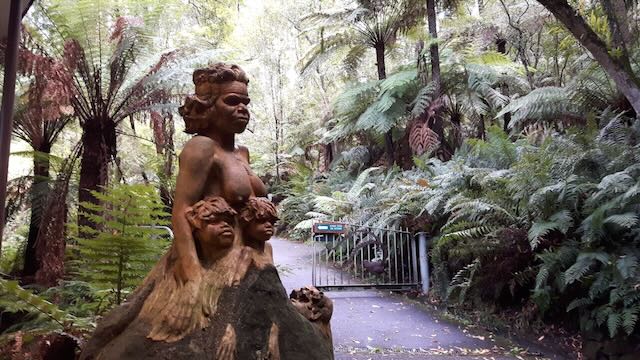
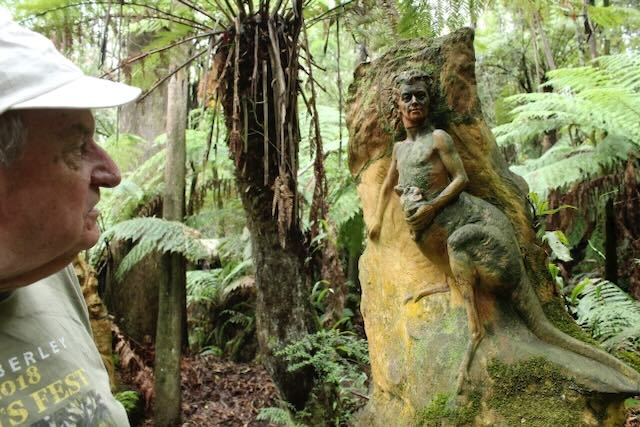
As we walked up and down and around the paths, marvelling at the luscious tropical forest ferns, fruits and trees, we both became enthralled in the story of William Rickets. He died in 1993, aged 95, having settled and lived in this woodland most of his life, creating this sculpture park from 1934 to his death, his sculptured figures, part man part myth, part aboriginal, some women, merging and evolving out of trees, woods, rocks. He was a self taught potter and sculptor. It was the power of his vision of a modern Australia that embraced Aboriginal spirituality and respect for the natural world that was his general message throughout his artworks. This spirituality made sense to me when I read that in the 1970s he spent two years in India, mostly at the Sri Aurobindo Ashram embracing his philosophy. We watched a video of him talking.
Lunch near by of white wine (Base River Sauv. Blanc, citrus and cinnamon).
Olinda Falls was a walk through giant cathedrals of Eucalyptus, yes, I am getting the names now, photographing their massive peeling bark, littering the ground like paper, under colours of sepia, grey, yellow, orange.
Our Air BNB is amongst all of this. Run by Charlotte, a teacher of wellbeing, her home is a100 year old, and the first home to be built on the mountain. Verandah style is what I’m going to call it. Down a forest road, it merges into, sits comfortably in, the massive Mountain Ash and all around . Yes Mountain Ash – the first tree I got to know.
Eucalyptus regnans, aka Mountain Ash, swamp gum, or stringy gum, is a species of Eucalyptus native to Tasmania and the state of Victoria. It is the tallest flowering plant and one of the tallest trees in the world, second only to the coast redwood.
With Charlots encouragement, after a rest we walked down to the Pig and Whistle, in the small town of Olinda (where there are more places to wash your dog!). After relaxing with a Shiraz wine, we found the pub had stopped food, so made our way back in the gloaming, full of bird song, settling for the night, and settle down our verandah, where Michael served delicious mushrooms on toast, washed down with Bushmills, and completed with some cheese. Around us the forest conversations of crickets and frogs. This place was magic. The night in Australia.The Queen of England is on their currency. There are battles with non indiginous species such as Ivy.
MELBOURNE
Our Air BNB apartment in Melbourne was our only disappointment. There is a certain delight in finding the critic, which I will indulge in later. For Melbourne offered two experiences.
Botanical gardens and Shrine of Remembrance. Trees again of course. The Shrine of Remembrance – a neo classical monolith which after climbing up we descended into the basement of corridors and displays of wars in which Australians had been involved in. All on foreign lands. From South Africa Boer, WW1 and 2, Vietnam, Syria. The familiar lines of Dulce Et Decorum Est (that old Lie) and Anthem for Doomed Youth embraced a wider catchment of out here, the choirs of wailing shells.
Through a random post on Facebook, (I’m going to Australia, any suggestions?) I found two connections, which sandwiched this venture, one at the start and one the end, both of which Michael welcomed to his already planned itinerary.
I’d last seen Sarah Durkin over 40 years ago. Although in different houses, we were prefects together at our convent school, New Hall. I knew she’d moved out here, along with Wiggy, (who sadly I would not see for she was in Sydney not on our geography)
Sarah and her husband Michael took charge, recommended and booked the restaurant (paid for the meal) near by called Pure South Dining, Tasmanian food. In contrast to our city sky rise glass and steel CBD, the waterside area was buzzing, alive like covent garden London.
Of course we recognised each other. It astonishes me how little we actually knew of each other then, except of course the essential things like personality. I didn’t know for example she was surrounded by brothers (4?) so she welcomed the contrast of girls and women’s company at our school. Nor did I know she came from Yorkshire.
She and Michael had met in London, (I think), bought up an American Franchaise and came out to set up in Australia. It was good timing. Called Home Instead, the business enabled older people to be cared at home. With their energy and drive, the business took off, and although they live and are based in Brisbane, they operate over Australia and travel widely especially to the US where the parent company is. They’ve done well. They say because they tailor the needs to the people rather than the people to the needs. They have had a successful 17 years of a professional partnership and a 35 year marriage, giving 2 children – Kirsty is god mother to one – David and Joanna, which come to recall we did not talk about. My pencil written notes after that evening are not legible, so it’s back to memory. The food, Tasmanian Oysters, Michael ate Wallaby I think, washed down with a serious quantity of quality red wine. There was a feeling of a great high after all these years a connection difficult to find words for, but somehow profound and easy, may be exacerbated by a delayed jet lag, or was it the wine? In any event, after an obligatory night time walk through Melbourne streets, we called for an Uber, and in it, I left my mobile phone.
I could have hugged him, the cool, kind Sikh taxi driver. Michael traced him through Uber, after jumping through a few what seemed like insurmountable hoops (Password?) We found him. He turned round and met us outside our Air bnb, so we could continue our journey.
More hoops to jump to leave the apartment keys – how could we lock up, post the keys through the flat letter box and get down in the lift to the basement (lift needs key) where the car was?
The Melbourne apartment
It was expensive, but M said, this is only once in a life time Rachel, so i booked it. It was in what they call the CBD (Centre Business Development – each town has one). Described in Air BNB blurb as ‘cosy’. Pokey is more like it. Not an inch of warm cosyness exists. Run by an agency, non of the warmth of Charlotte, our last host, we are left on street for an hour to await the keys. No window or air in M’s bedroom, so he suffocates at night, saved only by Barbara’s magnesium cream. The window, described with view of Botanical gardens, looks out onto the next door sky rise. If you hang out on the balcony, tempting virtigo, you can see the green of the gardens in the distance.
However, it was here, in this boxy space, that Michael began reading Chatwin’s Songlines. He’d had a life reading to Tamsyn, he said, and he missed it. He liked reading aloud. It was a new experience for me, and I came to look forward to it. He was a good reader, above all, a great mimic of accents, and there is plenty of dialogue in Songlines. So we began here.
This is also where Michael wakes up on the 84th year of his life. No coffee plunger to even make coffee with. I cannot find my little gift for him. Out, we said, and out we drove in Melbourne rain, to escape this cubical of catastrophe to find the Great Ocean Road.
GREAT OCEAN ROAD
Michael spotted the farmers market. His birthday feast was Momo’s from an Ausie Tibetan accompanied by Duck Wraps from a young travelling couple, washed down with Australian wine from an Ausie of Italian descent, where we settled on a gift for Helen, of Chianti and Prosecco, Italian grapes grown here.
Our only other stop was to the famous surf beach, Bells Beach, where on arrival a Surfer was descending the steps to the empty golden sand beach to enter the waves. We passed the signs to the 12 apostles, the helicopter rides, we caught glimpses of the limestone coast, but we pressed on. Australia was huge and we had a date at Warrnambol.
WARRNAMBOL
The eta got later and later, we did however make the last one, and drove into the drive of Helen and John Taylor at 7 in time to open the Italian Prosecco and drink Michael’s birthday health. I’d re-read Helen’s letter to Michael and Tamsyn as Michael drove, and warmed to the person I was about to meet. Her letter relayed the death of her great friend, the burning down of their apartment by a careless tenant, the tough obstacles life sends. A fellow teacher, Helen had come to London and stayed with Tamsyn and Michael, in Islington working in schools scoped by Tamsyn.
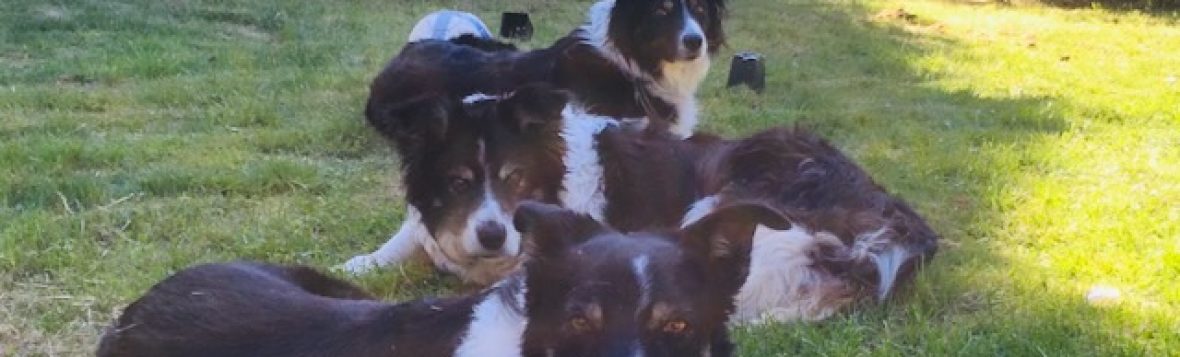
Their home is just outside the town of Warrnambol, a substantial house, set in 3 acres of land, with sheep doing the lawn mowing and a sheep dog, in fact 3 dogs were there when we arrived. One, who walked with a wobbbly drunk gait, belonged to their guests who were out for the evening, and they were dog sitting it. It was a delight to be amongst dogs again. Helen and John’s home is built by John and I’m impressed. The ceilings are an unusual 10 feet high (usual 8) the inside, finished in pine wood, is carefully pointed. I took a photograph of the door knob to the toilet, with the lock on the handle stopping it from turning, so much more practical than making a separate system to look. They were both practical. They were also generous giving us a huge welcome, giving up their days to take us around.
Oh what blessed relief after the pokey Melbourne apartment, to sleep in this spacious room and in between the most luxurious cotton sheets. Helen majored in History and English and is my first teacher of Australia. Now retired but in her time she had tutored a few aboriginal students and spoke about how very few succeeded into our western system, (and became professionals like lawyers, doctors etc). It was not only due to significantly lower rates of attendance and retention, but more due to a different world view. They lived amongst nature of which there was no rarity, but plentiful, so they was never a need to accumulate, or preserve for lean times. They would open a water faucet for example and leave it running, with no head of water scarcity. They lived for now. (we referenced the film, The Gods Must Be Crazy). The clash with the incoming western culture is dark and well known, the era of colonial and post-colonial government which did not acknowledge the Aboriginals. Part of it was inadvertent introduction of poisons. The early pioneer settler government gave financial incentive for a cull of the dingo dog who was considered a pest. The pioneers had little skill in hunting them, but contracted the more adept Aboriginals, and exchanged the dead dingo for sugar and drink. Both were poisons to the Aboriginal, as neither could be metabolised. Some became drunks and alcoholics and developed diabetes. A rectification movement began in the 1970s, a rehabilitation of Aboriginal rights, enacting laws specifically with respect to Aboriginal peoples as a “race”. Aboriginal positive discrimination steps in the form of grants, money, homes. Why should we work then, many of them said.
Helen’s is the first ancestry story I hear. Her grandmother was a Flannigan, of Irish ancestry, who settled as farmers from between here and Melbourne. The grandmothers son was the only one to marry. His daughter Wilfred Rose married a man from Ithaca who opened up a fish and chip shop in Melbourne. Helen is their daughter.
John’s family is originally from Scotland (?) He tells a story of how he was at an event with his father, who said, the man over there is your grandfather, but I don’t want anything to do with him. He was a curmudgeonly man, unliked and did not do much liking himself.
Flagstaff Hill Maritime Museum and Village.
The good and effective teacher Helen advised us to immerse ourselves into the Flagstaff Hill Museum to taste the salt of this area, feel the pioneering spirit, the turbulence of ship wrecks, and fragility of life here. The museum specialised on the colourful ship wreck history – this was the ship wreck coast. While we admired the famous Loch Ard Peacock statue valued at over $4 million, it was the story of Eva Carmichael, the sole survivor of the Loch Ard, that caught our interest. She was rescued by another hero Tom Pearce who hearing her cries swam out to her and bought her body to a cave, laying her on a bed of grass and shrubs and went for help.
Contemporary underwater videos showed the final resting place for some of the region’s ship wreck vessels. We watched from beginning to end, enthralled, an amazing film from 1929 capturing wild storms encountered by a handsome square rigger around Cape Horn.The photographer climbed to the crows nest, with his camera, to capture the open ocean storm water sweeping over the ships decks – like Niagara falls. Fabulous commentary. Just found it on YouTube.
https://www.youtube.com/watch?v=EpzUMg7_Zkg
Filmed and narrated by the remarkable Irving Johnson
https://en.wikipedia.org/wiki/Irving_Johnson
“Why do you do it? All for cargo. Cargo is King. If you don’t bring in dry cargo you may as well stay at home.”
“His whole body flapped like a sail. Something makes us do these things. “
We returned to the historic village that evening for a sound and light show re-living the history of the Loch Ard.
On our morning walk we passed a tree full of white Cockatoos. Or were they Pirellas that have come south due to lake of food and water? The rows of Pines in this landscape were planted for wind breaks, and like Laylandii, are no longer respected, for the wind gets under them, and nothing grows near them. Many are being replaced. Norfolk Pine, however, is indigenous – from Norfolk Island.
At the delightful town of Port Fairy, was an old whaling station (the bay was named by the crew of the whaler The Fairy in 1828) , now a laid back holiday beach. Here we dally in streets lined with clothes shops, and encouraged by Helen, I was persuaded to buy a stylish jacket and later Helen gives me a little black top to go under it. I am touched by her solicitude.
Just passed Portland (wood chip sawdust for Japan China for paper) we arrived at Cape Bridgewater. This wide stretch of wonderful beach was chosen in the 1960’s for the Marlboro Man Cinema advertisements (frequently mistaken for the US). Close by we stop by a fossilised forest. This is actually the ocean floor, which has been pushed up and is now exposed to the atmosphere. Here there are examples of fossils of underwater life and also middens where the Aboriginal people left their shells and food remains.
Our last stop was Tower Hill, were I saw my first ever bear Koala bear, which like Roo’s are marsupials. They get high chewing on the Eucalyptus leaf and fall asleep in a kind of stupor, John explained. The historic landscape of Tower Hill was painted brilliantly by Eugene Von Guerrard which has become the reference base on which the local people have restored the land to it’s original glory. A copy of the painting is put into the land deliberately so we can compare.
Warrambol Cemetery
The Warrambool Cemetery, near the Hopkins River, was once on the edge of the city, but now is now part of suburbia. Throughout this trip Michael indulged my interest in cemeteries, and this is my first. Helen and John dropped us here to meander for a while. It is like any English cemetery, with typical English Victorian death decoration of crosses, wreaths, headstones, pillars. Here lie the every day pioneer people, often citing where they have originated, from Ireland, Wales, Holland. An Urquart, there are many children. One ship wreck. Some very large families. It is the first time I see the signposted segregation that I will see throughout Australia, the demarking of sections into the sects, Presbyterian, Catholic, Methodist etc.
After our last evening meal with Helen and John, delicious with great red wine I recall, we came out to look at the clear sky and start. So it was I discovered the Australians call our romantic and heroic constellation of Orion, with the bright corners of Betelgeuse and Rigel, they call this complex and dominant shape, the SAUCEPAN and even shorten it to the Pot! For the first time I see Orion is upside down. Of course.
We talk once again of our origins, and find all three of us were bought up without fathers. Helen was lucky and her father lived well into his late 80’s. John’s father died when he was 11 years old. Michael, whose father died when he was 18, and myself aged 4.
I am leaving the best sheets I think I have ever slept between, and the most well made home I have stayed in.
DUNKELD
Malcolm watched us coming, he saw us drive pass and reverse back. We are in a huge landscape for where we can see and be seen for miles. The road is dead straight. The earth red beside, a base for dry savanna grass and huge Blue Gums in clumps. Yes, I leaned about Blue and Red Gums here, Malcolm was a natural teacher.
Malcolm was the one on duty to meet us. Taciturn by nature, his striking blue eyes, steadily watched the landscape around, taking in his thousand sheep. He was born here and had never moved. He told me that White Ant and Mistletoe were the scourges of the trees.
“People say, are you lonely here, but i have neighbours. Over there.”
In the far distance are some giant Gums which will protect the next homestead.
“We have 5,000 litres of water in our tanks, we don’t go short. Nor do we squander it.”
We are here for two reasons. To explore a different landscape and eat at the Royal Mail, a restaurant that another friend from school has recommended. That old girl network rocks.
To explore the landscape, we drove to Halls Gap and from there walked to the Venus Pools. The landscape is full of Kangaroos and it is the first time I have ever watched as they lounge in the heat of the sun, resting on their elbows in a very human pose, watching us watching them. The pools – with some but little water – were occupied by a rowdy playful group of school children, who left after we’d settled in with our picnic.
We took in Dunkeld graveyard just before
It’s in a beautiful setting outside the one street town, a luxury of space, shaded by stunning old twisted trees, in dry high savanna grass. Protestant, Anglian, Methodist Presbyterian – the usual segregation. And one grave on its own – what was the story? Michael, always good at finding the legend, found the family of Malcolm. I disturbed a fox, healthy and red, no doubt having an eye on a field of sheep near by.
Fine Dining at The Royal Mail, Dunked
Carrots with beef marrow crumble accompanied lamb (naturally)
Courgette pickle in Turmeric and mustard seed / Chicken liver / Lamb with purple potatoes.
We had 3 waiters, a New Zealander, a Chinese, and one local, a son of a farmer who did not want to farm – he was classically camp.
All washed down with a vintage Patricks Cab Sauv.
Bruce Chatwin in the morning is the chapter on ‘No Thongs’. It’s a sign outside the bar to discourage Abos.
The best morning run here along that long straight road. I want to come back here.
Breakfast with Eva and the Kelpie, their beloved sheep dog. Later Eva texted us to point us us to the Kelpie centre at Castleton, which we called into.
Botanical Gardens for morning walk where we met a volunteer repairing a post.
‘They’re dangerous those Red Gums. They loose their limbs, they are hollow inside.
Can I go up to those Roos?
No
Why?
They’ll run away
Michael’s 3 animals and 3 reasons why
Lion – because strong, it is handsome it is faithful to its family
Ox – because it is strong, it is handsome, it is hard working
Dog – because it is affectionate, it is obedient, and it energetic.
PENOLA/ CARNAMARRA
Penola is one of the oldest towns in south-east South Australia, some 5 hours drive from Adelaide. Although the population is tiny (1,400), the town has become famous for its association with Mary MacKillop (1842-1909), a nun who in 1866 established Australia’s first school to cater for all children, regardless of their family’s income or religion. I’d hear about Mary McKillip – Australia’s first saint – from Liz and Peter, our air bnb hosts. We’d chosen them as their home was in a vineyard, 10 acres. This was our base to visit the Coonawarra Vineyards. Theirs was the wine that was added to the mix.
Like Nuits St George, the vineyards are all along one road, limited to the geology – red earth soil over limestone (an arial photo shows the limitation, 27km long and 2k wide) The first to visit was the wine we had last night at the Mail, Patricks of Coonawarra, where we saw blown up on b&w a portrait of the salesman who came.
At Brands we sat beside the oldest vines and had our picnic. Our last was Di Giorgio, one of the few not bought up by a Chinese conglomerate (Holliks had just been sold)
Liz and Peter were eccentric and welcoming. Liz did the talking for both of them. Her ancestry, German and Aborigine, was expressed as follows ‘I said to Peter, G’day Brugger’!
Once she heard I wanted to visit Cemeteries, she was determined to be my guide.
‘We’re going to all the cemeteries’, Liz announces to the Oak bar cliental later.
‘I’ve started going to the gym. I’ve got my own personal trainer you know’.
Penola Cemeteries were on the face of it the most uninteresting, with name date of birth and death. Except Liz knew most of them.
‘She had 3 children but only the other day I heard actually she had four, and one was bought up as her sister.’
After the Old Penola Cemetery Liz took me to the Prime Family Plot to meet the MacPhearsons, the bank manager who took all Peters family’s money as he was 2 days late with the repayment.
‘They are rich. But they are not happy. They were always sad. One – this one – committed suicide.’
We dined at Pipers of Penola (Liz took us there and back). A modest single room like a converted chapel.
After all that Cab Sav, lets have a Shiriz, we said.
Good choice, she said, its my husbands winery. A perfect accompaniment to 7 times beef. Some relationship to the amount of fat running through the meat. Michael’s mouth salivated in anticipation!
PENOLA to KANGAROO
An envelop on my pillow. ‘Be my Valentine. From Guess Who?!”
Inside a necklace aboriginal in concept of a fish for strength. I am not used to receiving gifts or this attention. I am touched by M’s playfulness.
I ran along Petticoat Lane to Station House, still heavy, full of the rich food from last night. I declined breakfast but gave in when I smelt that bacon perfume. Last photograph of Liz on her verandah. They are selling, or rather hoping to sell the 10 acres of vineyards and the house. ‘They not separate,’ Liz affirms, as she enters into her busy day with prospective purchasers.
It is the day of our Long Drive. Our first stop was a dead end. “Closed due to Bullshit” the candid notice announced. We did not have time or inclination to garner the story, but clocked the Australian bluntness. Instead we stopped later, to view Pelicans in an open swath of water and watch them flying up wards circling into the thermals.
People we’ve met on the way, and today, say: “What! Only one day on Kangaroo Island”. Yes, we are mad. But it’s two nights.
We reach the ferry in good time, and on it meet a German woman from Friburg who is watching their hired camper back into the boat with her husband in it but driven by a local to ensure packed in. “My husband is a good driver”, she needs to explain. So we begin. They live 6 months in Cork on the Bara peninsular,and know Gerd and Rich and Rupert. Make contact she said, and welcome to come and stay. We have a spare place we rent out.
The second person we met was a tall man sitting alone, and I asked if we could share his seat. He was a Kangaroo Island Sheep farmer (since 1972) and talked the price of sheep meat and wool and wheat. ‘It’s good right now, but it fluctuates and you never know tomorrow. Avoid Seal Bay he advised, it’s too expensive, and go to the far west of the island where the seals are plentiful and free.
The tarmac road is lined with gum trees. Our address is The Two Aunts, Forth Street, SaphireTown, Kangaroo island. No indicator quite what it seems. Saphiretown is a very loose collection of homes in the bush towards the waters edge, which we only uncover the next day. Forth Street is a red dirt track. The Two Aunts is a delightful shack which we have completely to ourselves. It is immediately intriguing. But first for the outside. We are in the bush. The ‘pay attention for Tiger Snakes’ warning did not reach me until later, and I ventured out, making my way through the undergrowth to what I knew was not far away, the waters edge. And there it was. I breathed out. We’d arrived shortly before dusk, and I went back immediately to collect Michael, finding a better easier way to reach the waters edge. With the binoculars we watched a swath of birds, that M was convinced were penguins, but now we think are Australian Cormorants. We cook for ourselves, drink Australian whisky and relax in the darkness and night around us.
‘I want to spend a month here’ I declare
‘I want to spend tomorrow here and not go anywhere, respond M.
That night I hear a noise outside my window. Ah the bush. I am way out of depth, in awe of this place. Next door Radio 4 is speaking to Michael.
We both woke early and immediately walked out to the water, turned left and walked up to the headland. Kangaroo feet in the sand, and up one pops, taken as much by surprise as we are, and off it hops. Round the corner, passing a rustic grave of Ben, we walked, with American River separating us from the further shore. We cut back through some bush, this time surprising a family of wallabies.
Our ambitious days plan (yes that one to stay still and not move did not last into the morning) to drive to the western end of the island as advised by the sheep farmer is thwarted by a flat tyre, and the day is effectively taken up with various stages of tyre repair. Taylor the tyre people being based at Kingscote, we enjoyed a picnic under the shade of an historic Kingscote Park, where to my delight I found a fascinating Pioneer cemetery, the best yet, and full of stories.
But on we must press for the time was ticking and we had a ferry to catch that evening. We squeezed in the expensive, and very touristy trip to Seal bay. It was easy to navigate, with guaranteed seals to look down on taking their afternoon siesta’s in various positions. Many oriental tourists taking the obligatory selfie with seal.
Waiting with us at the ferry was an Ugly Dog lorry, transporting seed potatoes to the mainland. This is the business of the sheep farmer’s son – the farmer who we met and talked with on the journey over all that long time ago of yesterday.
ADELAIDE
Adelaide was our focus for two reasons. The main one being it was the departure of the Ghan, the train ride at the centre of Michael’s Australian trip and to which I was latterly enjoined. (my set of instructions included, compulsory evening dress). It happened to also be at the time of the Adelaide Fringe Festival, and for Michael, with his Edinburgh Fringe history and life in theatre, this was a natural bonus.
An amazingly easy smooth road structure coming into Adelaid, M2, A2 and A5 before we found McClaren Street, and our bungalow, an old style, for the night. Because we were earlier than expected, our hostess Fiona was not there, so with ease we took ourselves off to find some fine dining, which by chance, or rather Michael’s amazing nose for good food, we did. The street at the end was packed with diners, but Michael choose Chianti, and we had a ball, as well as a fishes head. The head was recommended by the waitress, a resting actor, who enjoyed to banter ‘The eyes are taken out’ she assured us. Cooked with soya and good spices, it was meaty and delicious, washed down with Kangaroo Island wine.
Fiona’s home – where we are staying for 2 nights – is in an historic neighbourhood of what were workman’s cottages built in 1876, bungalows with veranda’s covered decorated with metal tracery, gardens demarked by white picket fences. Like many others she has a blue plaque on hers. Inside, tardis like, is very spacious and she has renovated with good style. Our room is the front room, beautifully appointed, but a long way from the bathroom toilet at the other end of the house. She lives somewhere in the middle.
Having returned the motor to Hertz (meeting another who’d had a puncture on Kangaroo Island) we walked to the Fringe Festival taking in a few museums and moments along the way, all handily in one street. As we saw from our journey in, the city centre is framed by a square of generous Parkland, with the river on one side.
I suddenly felt connected, finding the Lone Pine here. Four years ago I stood on the Lone Pine battlefield in Gallipoli, took a photograph of Kali in front of the Lone Pine, as a gardener tended the War Commission graves of young Australians who gave their life for this often futile battle of WW1. The Pine here, grown the seed of the Gallipoli Lone Pine, gave shade to us now. It was one commemorative detail around the very impressive National War Memorial, where no doubt Anzac celebrations are held every year. Begun in 1919, the memorial was was the first Australian state war memorial to be confirmed after the war. The design shows the prelude and the epilogue to war, depicting both the willingness of young men to answer the call of duty and the extent of the sacrifices which they made. There is no bravado or material victory here.
The South Australia Museum, acknowledged the land on which the museum exists is that of the Karuna tribe and inside gave us a snap shot into the Aboriginal life here. Aboriginal death rituals revolve around their belief that the Ancestral Beings were responsible for providing animals and plants for food. Religious ceremonies in honour of the Ancestors were a vital part of everyday life, to ensure the continuing good fortune of the community, and safe passage of the sprit into the afterlife. Aboriginal communities use both burial and cremation, with ceremonies that can last for days and even weeks. I was glad to hear children may be taken out of school in order to participate.
Adelaide Fringe is huge. It takes over one of the corners of the Park square with tents, marquees centered around Garden of Unearthly Delights and Gluttony. While in Gluttony reading our legends trying to figure out where to go, we got easily tempted into the Jumping Flee magic show, where we were invited to imagine the flees jumping, a revival of a Victorian entertainment. To enjoin the comedy I suggested a bargain price, 2 for 1, and got thoroughly put down! (I think i’ve located him – Freddie the Magical High Jumping Flea by Jonathan Royle).
After packing for our Great Ghan adventure tomorrow we came out early evening with Fiona to enjoy some Oysters (Fiona, not liking them, watched us) and white wine. We gathered a little of her story, which included her ex husbands Rolf de Heer’s film Ten Canoes, 2006. Her halcyon days were as a journalist, her ancestry Scottish, her father a diplomat so she was bought up internationally. She has two beloved daughters, one with a child. She is very good company, bright and playful.
The evening Fringe Performance we see is 4 bearded me on Roller Skates. How do we choose? We asked a passer by who was painting up a stage. We’ve got one night, we said to him, what would you recommend. So it was we got 2nd row in a packed hall, and watched the easy contorted dynamic between 4 bearded men and 2 unbeaded women, sometimes on roller skates at the University of Adelaide, Cirque Alfonse, Barbu.
NO GHAN
At 6am Michael wakes me.
‘Is there a problem?’
‘Yes, there is a disaster. The Ghan has been cancelled and do you have a middle name?’
Doing an early morning check on email, Michael heard that the great train was cancelled, due to a car buggy derailing. Undeterred, he was working on a plan b, booking a flight immediately to Alice Springs. He is the Lion. There were a few hoops to jump through, like passwords and web sites, which we failed to accomplish so plan B let’s just get going.
Fiona rallied to our mission, got swiftly dressed and drove us to the airport (via the Ghan station to confirm the facts). Within 2 hours we were on a flight to Alice with an Air bnb booked. On the plane I draft up a letter to the Southern Rail to argue compensation of a flight back to Oz to get on the Ghan again.
ALICE SPRINGS
Our young taxi driver from the airport to our Air bnb introduced us to Alice. Well after Chatwin of course.
Are you from here?
Almost i’ve been here 12 years.
You must like it here, why stay?
Because everyone here comes from somewhere else.
We are in Australia’s geographic centre. The name Alice Springs was given by the surveyor William Whitfield Mills after Alice, Lady Todd (née Alice Gillam Bell), wife of the telegraph pioneer Sir Charles Todd. We drove over the dried up Todd river, saw the Macdonall ranges to the north.
A bit about the locals, Arrente, Pioneer settlers and Afghan cameleers.
The Arrernte Aboriginal people have made their home in the Central Australian desert in and around the site of the future Alice Springs for thousands of years; evidence suggests Indigenous occupation of the region dating back at least 30,000 years
A white settlement was started 1860 with the construction of a repeater station on the Australian Overland Telegraph Line (OTL), which linked Adelaide to Darwin and Great Britain. It was completed in 1872. The town’s first substantial building was the Stuart Town Gaol in Parson’s Street, built in 1909, when the town had a European population of fewer than 20 people. Many of the gaol’s first prisoners were first-contact aboriginal men incarcerated for killing cattle.
The original mode of British-Australian transportation in the outback were camel trains, operated by immigrants from Pathan tribes in the North-West Frontier of then-British India. They became known locally as Afghan cameleers, and many moved to Alice Springs in 1929 when the railway finally reached the town. They lived on the block where the town council is now, transporting goods from the rail head to stations and settlements to the north.
A gold rush in Tennant Creek in 1932 kept the wheels of the Alice Springs economy turning until the outbreak of World War II.
During the war the population of Alice grew from 500 to 10,000 with evacuation of Darwin, and transportation of troops up.
During the 1960s Alice Springs became an important defence location with the development of the US/Australian Pine Gap joint defence satellite monitoring base, home to about 700 workers from both countries. Currently, 2,000 residents of the Alice Springs district hold American citizenship.
Alice Springs was connected to Darwin by rail on 4 February 2004, when the first passenger train arrived in Darwin from Adelaide. The Ghan
In my haste to book an air bnb I did not look at scale, and we found our Air bnb is outside the town. Simon, however, is welcoming and acknowledging this inconvenience lends us their car, a man sized Toyota, which I drive to town to get provisions.
Michael’s planning mind is still turning viperously, and with his customary charm he solicits Simon’s invaluable help to book us onto a coach going to Uluru leaving early tomorrow morning.
In Alice town we find not shops but rather a surfeit of police station and court houses. It is an American style grid structured modern town, and in search of the supermarket we drive up and down the parallel streets.
I met my first Aborigines in the supermarket. Although 3% of the Oz population, they are about 30% of Alice population. I see their stick thin legs, bare footed, ferrel kids running wild down the conservative supermarket alleys.
Of all the bars in all the town, Michael finds us Todds bar. How did he choose? From a random list of bars on Google, Todds turns out to be the model for Frazers bar, the No Thongs bar frequented by Bruce Chatwin in Songlines.
Information found later on the web:
“Back then, the Todd Tavern was still a place where “doggers” (men who spent months in the bush poisoning dingoes with strychnine) would come to drink away their pay. One regular had the habit of shooting the pub phone with a pistol (“because he hated modernity” one local told me), and then solemnly paying for its replacement when he sobered up. There was apparently never any talk of him being barred or disarmed. Today, the Todd has a decent wine list.
On Chatwin 30 years on (Richard Cooke – Crankhandle of HIstory): As he tried to make sense of what he had seen in Alice Springs and its surrounds over a total of nine weeks in the early 1980s, he wrote that songlines were on “such a colossal scale, intellectually, that they make the Pyramids seem like sand castles. But how to write about them – without spending 20 years here?
His project had the potential to rub almost everyone the wrong way. He was a dilettante fiddling with anthropology, a white poking around sacred business, a bleeding heart consorting with Aboriginal people and their allies. And, above all, he was an effete Pommy with baby-blue eyes, a plummy voice and a fancy notebook. Alice was heavy on the yang, and in the recollections of those Australians who met him there is still a divide: men bristle (“everyone thought he was a tosser” was one frank assessment), while women pine.
“Alice Springs in 1982 was a town full of the promise of violence, latent or otherwise. It still feels a bit punchy today, but when the 43-year-old Chatwin arrived this “grid of scorching streets” was also latticed with tensions. The Aboriginal land rights movement was in its ascendancy, and the town’s white shoe set were very unhappy about that. Indigenous voices were asserting themselves, and a phalanx of politically engaged white Australians, some of them anthropologists, were helping them.
https://www.themonthly.com.au/issue/2017/september/1504188000/richard-cooke/crankhandle-history
Today in the Todd Tavern there is the ubiquitous piped music, outside there is a table of regulars smoking, that do not invite us passers by.
Back at our self contained apartment, while Michael attends to his log, I scope out the cemetery. While the town was too far away, the cemetery was around the corner, and while passing an interesting grave from the road caught my eye.
It turned out to be that of Harold Lewis Bell Lasseter. The writing said:
“Died in the Peterman ranges on January 30th 1931. His grave was located on December 14th 1957 by an expedition led by Lowell Tomas and Lee Robinson. This is his final resting place.” What’s the story?. He’s squatting, a chubby bearded man, panning perhaps for gold. His story unfolds the next day on our unexpected bus.
Many pioneers – She was a pioneer who inspired us all
Simon, our host, drove us to meet the bus at 4.30 in the dark morning. Amazing.
‘Welcome aboard the tour to Darwin’, says Darya to us. ‘Just checking to see who is awake at 6.30am! … Any Germans here? No? That’s unusual. Well we’re about to drive the equivalent of the length of Germany, 451 Kilometers.”
We are going to Uluru, a massive sandstone rock, sacred to the Pitjantjatjara people.
1976 Land Rights Act – (same time as Chatwin here).
On the bus to Uluru M read Bruce Chatwin on the purity of the Nomad. How the nomadic inclination was not just a wider human tendency, it was almost a moral obligation. Agriculture had been a mistake. Cities had fostered violence, not culture. As we motor through the the bush dawn breaking I imagine I see the flash of red of a tall Massai walking in the savanna landscape. Our road is called Stewart after John McDonnell Stewart, one of those courageous pioneers who traversed from South to North mapping as he went for telegraph communication. Alice Springs was a repeater station. That’s how this heart of Australia began.
Passed a salt lake – reminding us of when all this land was under water.
Passed Mr Conner in the distance, which is older, wilder and often mistaken for Uluru, photos taken and returned none the wiser.
Dayra tells us the story of Peter Sevrein, the farmer. Considered a pioneer in this area, he ame here in the 70’s at the age of 16 and now owns Curtin Springs, a “million acre” property in Central Australia. After he bought his first tranch of land aged 26, Rain came in the first year, but after that was 9 years drought, (the Great Drought in the late 1950s). Tourism was something new then. Ayers Rock was 105 kilometres down the road and was starting to attract visitors. Peter provided a refuelling station for tourists starting to come to Ayers Rock and while the tourists waited for the refuelling, Dawn began providing tea and fresh scones. A new business was born. Curtin Springs was the first Wayside Inn in Central Australia.
Our group consists of a large American, and smoking French who have stylish hats with nets to protect against persistent flies.
For 35,000 years, people have been living here, ‘documented’ in the famous Songlines. (the ceremonial songs of Aboriginal Australia absolute vintage is unknowable, but the best estimates run to at least 12,000 years old.) The Europeans enclosed the land. The 1976 The Aboriginal Land Rights (Northern Territory) Act provided the basis upon which Aboriginal people in the Northern Territory could claim rights to land based on traditional occupation. The Act was the first of the Aboriginal land rights acts, allowing for a claim of title if claimants could provide evidence of their traditional association with land. Today about 50% of the Northern Territory land and 85% of its coastline are owned communally by Aboriginal peoples.
Around Uluru the land is leased to European travel agents, who market Uluru. The popular sport of climbing this sacred mountain is ceasing this year (2019).
Trees of the desert: Desert Oaks – fether duster, the seeds that need fire to germinate
Desert Heath Myrtle. Bug Bush. Mulderbush spinifix grass – seed cake and glue. Red Gum trees
Our first stop was a walk to a gorge to feel the heat and geology. 550 billion yeas formed, tectonic plates trust up. Extreme erosion. Inland sea came in and covered all. Metamorphic process form into conglomerate rock and sandstone. Like tears of grey coming down the rock face. A 30 minute walk in 49 degrees heat and flies.
KatamTjuta, sacred to the Anangu people.
Mutitjula Cave. By now most are in netted headgear to protect against the persistent flies. We are shown some original rock paintings. ‘Guides used to throw water from water bottles onto them to make them stand out more for the tourists’. Our guide is full of these anecdotes reflecting how tourism has changed, now more respectful for the local Anangu people. I am grateful to see some acknowledgement of the heat – Track closed due to heat.
There in the distance that famous table top of Uluru. We arrived – as the brochure promised – in time for sunset, with at least 50 other busses. It’s hard not to take photographs of people taking photographs. It’s hard to absorb this enormous rock because I’m feeling nauseous with the heat of the day. Unlike Michael who happily sits down to drink a glass or two of Merlot wine, and eat the processed BBQ and picnic food our good guides prepare for us. My note are sparse: 49 degrees heat and flies. Conglomerate and sandstone rock. Birds nesting in rock.
Alice – Cultural Centre, Gallery and Air Museum
From our home in Alice we walk to the Cultureal centre which is active with women crafting with felt, silk screens, gem cutting. Rich and inspiring. A collective nourishing and inventing and fun. M bought me a ring made by Megan, who was busy pulling coloured paper out of thrown away books, one of which was a pressed flower collection. She also cut up her unused canvases for book covers. Genuine self recycling. I wear the memory of her green and red gold colours of the Australian bush.
In the gallery intimate paintings by the aboriginal European artist and todays dot ad non dot artists.
Yet more was in our neck of the woods. Our road is called De Haviland road, and the Air museum is around the corner. We watched a film of Edward J. Connellan, who founded Connellan Airways in 1939, told in his matter of fact clear direct answers. Flight was the first time connecting these disparate places, facilitating pioneers to settle. Mail freight and of course the flying doctor. He built one runway after another to leap frog, enabling the refuelling.In wet weather they needed a 5 tonne lorry to drive up and down the runway to see if the ground too soft or not to land.
Last visit to the graveyard where I found all sorts that i’d missed including the artist and the Connellan family. Failed once again to find the Afgan graves, heat and flies augmenting.
Michael reading Chatwin. Interlocking series of lives or ways through, adapt to meet uncertain rain and weather. Trade route is the song line. A mans verses were his title deeds. Uleru is the pace were songlines converged. Their stories, often called creation myths, always reference the beginnings, and this feels enormous to me.
Darwin
North we go towards the heat and the the equator, and 80% humidity. Below us green grass, woodland and clouds. The air port bus drives along Stewart Road, began in Alice Springs. The driver born in Adelaide took 7 years to make it to Darwin. Left behind a broken marriage, wife and dog. ‘I loved that dog’ he repeated. I’ll never go back. I’m 63, my arthritis has disappeared I feel 40.’ He was far more interested in a lone woman on our journey also stranded by the Ghan cancellation.
‘Number 6 bus AS3, that will get you there’
Another seed from the Gallipoli Lone Pine was planted here.
With a full moon, the Great Nose located Wharf 1and an oyster bar where we washed down 2 dozen oysters with a delicious Margaret River, Sauvinon Blanc. (goosberry, citrus. flowery, passion fruit). A German waitress gives us the knowledge: No way swim in this sea, crocks, stingrays and jellyfish abound. Some crazy people walk the beach, far too dangerous. Beside us is the controlled sea swimming pool, a gated community.
Facing the Crocks at Crocodylus
In the Crocodylus Park we met Teddy and Tetley, Grandma Suzie and Posie, whose main boyfriend is Prince. On a boat with metal bars to protect us, we learn that they do not chew with those famous teeth but swallow whole (the teeth are used as clamps), and often swallow stones to help with the digestion of a whole chicken. One is thrown to a lazy crock, and we watch the process.
‘Some materials they find difficult to digest such as Emu fur and human finger nails (!)’
We saw a crock nest, a chaotic collection of twigs and dried grass a meter diameter. As if knowing the future, a good hight above current water level. They lay many eggs of which only a few hatch. Each egg contains the possibility of being Male and Female and depends soley on temperature which it will become. As female hatch at 2 degrees higher with climate change we may only get female crocks. 3 month incubation.
At the end, safe back on land we both held a baby crock – even at this size, it’s mouth is fastened with strong tape. The eyes are the most fascinating, the double lid, outside down, inside across. Like goggles.
The park was a veritable zoo and as we walk round I am reminded of the Life of Pi, right at the beginning when he addresses the morality of keeping captive wild animals. With the need to hunt and to survive removed, they adapt to a far less stressful life, and live longer albeit more sedentary. We saw tigers here, caged of course, in a good tropical spaces, snakes, meerkats, a sleeping dingo, watching emu, wallabies cassowaries. It was a conversation with a Vietnamese woman (‘Are you a research scientist?’ she asked seeing me writing, and I enjoyed that possibility for a moment) that struck the conclusion. While we tame lions and tigers, we never tame a crocodile.
Aviation museum
Owen still works here (has done for last 20 years) and remembered Kate Kellett, who visited over 5 years ago. ‘Such a nice girl’, he said. ‘I remember she didn’t know the type of plane Richard flew.’ Owen, naturally, did. He knew all details, and researched more as we went round. He solved the mystery of the plane that crashed in the desert. Eventually it was retrieved piecemeal and re-assembled then used as a training plane before eventually being scrapped. He also added to the Dorothy story, Dorothy who had married Richard and was the daughter of Aubrey Abbott, the Governor General of the Northern Territories at the time. Aubery Abbot had been reassessed in a new book published on the recent anniversary – 80 years – since Darwin was invaded. (I had no idea it was until now – it was the Japanese who came down). It transpires Abbott was more interested in making away with and saving his collection of porcelain than saving Darwin.
Inside the hanger, was a huge Boeing 53. (alike but not the B29 that dropped the bombs over Hiroshoma), it was called BUFF – Big Fat Ugly Fucker.
This bloody town’s a bloody curse
No bloody trams, no bloody bus
And no one cares for bloody us
Oh bloody, bloody Darwin
Fascinating story of the flamboyant Jessica ‘Chubbie’ Miller, (https://en.wikipedia.org/wiki/Jessie_Miller)
which accentuated the race for record climate in which Richard made his record breaking long distance flight. (Posters describing England to Australia – Word’s greatest Air race)
In 1927, aged 25 she met Lancaster at a London dance. Leaving his wife, Lancaster and Miller departed from Croydon in a bi plane Avro Avian called the Red Rose, on an attempt to set a long distance flying record from England to Australia. It became a 5 month romanic adventure. They arrived in Darwin March 1928 as lovers. Although 24 hours late, a huge crowd greeted them on arrival in Darwin, and on their subsequent tour around Australia.
In 1932 Miller became romantically involved with the writer Hayden Clark, to Lancasters dismay. After Clark was shot dead with Lancaster’s gun, Lancaster was accused and spent 3 months inside before bing acquitted.
In 1933, Lancaster, attempting to re-kindle his reputation, set out to beat Amy Johnston’s record, was lost across the sahara. 29 years later his mummified body was found, along with a note describing his love for Chubbie and pain and thirst
Miller remarried a test pilot, Pugh in 1936, who Richard surely would have known.
‘Now heavily in debt, she returned to England and worked as manager at the Commercial Air Hire Company, owned by Mary Bruce and Irish pilot Johnnie Pugh, a decorated RAF officer. Miller married Pugh in 1936, moving with him to Singapore and Spain, and then back to London. She died in 1972, never having returned to Australia.’
Michael took me on my first ever Helicopter flight. As we take off, I thnk, but the gate is closed. Ah it doesn’t matter, we are above that ground limitation. No G Force. I am in the compound eye of the machine. We circled towards Darwin, and saw where Richard would have landed, the old runway now part of a sports complex. I am reminded of the beginning of HG Wells time machine, landscape changing over time. Back over Charles Darwin Park, no doubt full of crockodiles.
Charles Darwin never came to Darwin. On 9 September 1839, HMS Beagle sailed into Darwin harbour during its survey of the area and John Clements Wickham named the region “Port Darwin” in honour of their former shipmate Charles Darwin, who had sailed with them on the ship’s previous voyage which ended in October 1836. The settlement then was known as Palmerston but it was renamed Darwin in 1911. The city that we saw from the air has been almost entirely rebuilt four times, following devastation caused by the 1897 cyclone, the 1937 cyclone, Japanese air raids during World War II, and Cyclone Tracy in 1974.
Palmeston Cemetery
The extraordinary ordinary stores of everyday pioneer folk from 1830. Few are over 70 – one notable at 90 – frequent birth deaths of twins, with a whole area dedicated to these.
Mixed races, Malay, Chinese Greek even one Norwegian. Scotland a common name origin.
Pioneers Annie Margaret Widdup, Hugh Farquarson, like Cecil Alexander Goodman, who lived most of his life int eh Back country
Joseph Cowan, Gold prospector and ‘knokabout man’, travelled all round Australia, mining Burke town, son of folk from Scotland, born Birmngham died Darwin. A typical bushman, a hard drinking hard working prospector and a family man.
A children’s area. Exotic birds
Lillian Cubillo – approximate age 54 years.
Eliza Sarah Brown, accidentally killed (aged 38)
Peter Macrides Chico – accidentally killed. A Norwegian, Captain Oscar Hansen, from Larvig,
The well known Constable Albert Stewart McColl, killed by an Aborigine at Wood Island whilst in the execution of his duty.
Pioneer Hilderbrand William Havelock Stewart, pastoralist, business man, founder of the Live Cattle Export Trade from Darwin. Died in Singapore aged 90 years.
John George Knight, a popular occupier of many positions of authority including President.
Died at sea.
A few freemasons, like Paul Foelsche foundation master of the Port Darwin Lodge
In summary I found Darwin gritty, green and graphitied. Green Room at Darwin Airport, while eating a delicious wrap (not hungry once again). Kathy sent a message to M, saying do not exhaust Rachel. I look across to M, who with a pleasure across his face, is eating, eyes down scanning the plate. He has bought me a ring, a book mark, endless meals, coffee, ice creams, and recently a helicopter flight.
Do you mind sharing a room, he asked at the beginning. ‘I am quite harmless’.
PERTH
Another and final old fish connection. Liz Matthews – who happens also to be a relation of Clive Matthews of High Easter. Curly Matthews met us at the Perth Airport – what luxury.
We are in the company of two heads – she was head girl, and Michael was head boy. Later Liz reveals that she kept the residue of the feeling she had when elected (now 40 years back) that the nuns had wanted the daughter of a Foreign Office Ambassador rather than what they got, the daughter of a farmer. So how did she rock here after New Hall and Essex? She came out after an overlander via India, met and married an Oz man, and had 3 children. After this marriage had fallen apart, she met Greg, North and South Perth, moved out of Perth, to Mandurah, which is where we drive to after a whistle stop view of the town. It is mirror glass and city slick. They drive us to a park, where we can see a view of Perth and where people are collecting to watch an open air play, and to a monument in memory of Anzac Bluff. (I wonder if i would take a visitor to the British equivalent?)
At night we can just see the black treacle of the water outside their back garden – we are in the Venice of Australia, the backwaters. South Yanderup, near Mandurah, an hour south of Perth, on the south bank of the Murray River. In the morning we begin to see the geography. It is built upon a network of canals at the mouth of the Murray River, with water front residences – popular retirement place for many Western Australians – some like Arab palaces. Only one road connects the township to Mandurah and Pinjarra.
We breakfast with John and Julia who’ve driven over for a morning paddle. They are keen to relay their rich ancestry stories, he from Sicily, she from Croatia. John’s Sicilian family were stonemasons, who came over and built them a house which they still live in.
We are both shattered, Darwin time.There is a little bird with a fan tail that comes for food of meal worms. Greg, very proficient with technology, made a slow mo movie of it feeding.
On my morning walk I lost which house we lived in. Walking is not the most popular way of getting about. We board Greg’s boat, which is waiting for us at the bottom of their garden. Water front, surf shops, private homes in architectural diverse styles. Areas still undeveloped, a nature reserve.
We motor out of the Murray to the Ocean. The Indian Ocean.
How could we not? Both of us swam. Assured it is safe from Crocks, I swam with Greg to the shore and back, well out of my comfort zone – it had been along time since I did this (Caribbean?) . Later seeing a phone movie Greg took I am surprised how stylish I look doing the crawl! Michael could not resist, and was in the water by the time I got back. Greg assiduous in his care threw out a rope for safety. The pleasure on Michael’s face was a joy to see.
Is it safe from Crocks? discussion continued as we drank Marguarita’s in the Ocean bar. We look up death by dangerous animals statistics. Mosquito is top, followed by People, (oh yes!) followed by snake, then dog, then Tseti, Asian Bee, Freshwater snails , round worms, tape worms, then finally Crocodile (followed by Hippo, Elephant and Lion (joint) Wolf and Shark.
‘Not since Rosie Clark who I do not know from a bar of soap, – who evidently said Oh yes, I remember Curley Matthews, she was bossey!. So I can no longer say or direct what instinctively I’d like to!’
Back in Songlines, Bruce is with Archady in the bush with a local tribe. Flies are feeding from the corners of their eyes. (I now know this well) Lollies are sweets. Abo mix western tribe, you cannot got back. Karma, done bad come back as snake or rat.
Paddling is delightful. With Michael in a canoe, I paddle up stream along the river, beside Liz, who is quite competitive. For the evening we dine out in Ravenswood, on the banks of the Murray River. Burgers, Pizzas and salads.
With Liz’s adorable huge eyed grand daughter, we motor out for the last time in the boat, this time to an old windmill, run by the pioneer Coopers family on Cooleenup Island. Joseph Cooper built a house, cleared the land, and became the largest grower of wheat in the area, then built a mill to process it. Joseph died in 1857 and his descendants have lived and worked the land since.
Liz and Greg could not have done more for us, they were brilliant and energetic company. The Old Girl network struck gold again.
SINGAPORE
After a 4 hours flight bleary eyed we emerged into Singapore airport, drugged or just tired? Luggage dropped at our Scarlet Hotel. Michael had so wanted to book into Raffles. ’It was where Coward always stayed’. But it was being refurbished. (A colonial-style luxury hotel, built 1887, named after British statesman Sir Thomas Stamford Raffles, the founder of Singapore. Now owned by Qatar-Hospitality.)
Our Scarlet Hotel is in a delightfully un sky-rise and old part of town, near China town, the hub of old opium dens and deals. It is off Pagoda street, dominated by a Hindu temple Mariamman Temple. Chinese and Indian. Chinese account for more than 75% of Singapore’s multi-racial population, with Malays and Indians making up much of the remainder.
We wanted to explore.
Our ambitious plan was to WALK to the Sky Garden, to feel the land on which we’ve landed, see the people, get a map in our heads. We arrive nearly an hour later at the foot of the iconic building Marina Bay Sands (Safdie Architects) owned by Las Vagus Sands 2010, the worlds most expensive casino and 2,500 room hotel. The three hotel towers are connected at the top by a park that brings together a public observatory, jogging paths, gardens, restaurants, lounges, and an infinity swimming pool. At 3 acres, it is longer than the Eiffel Tower is tall and large enough to park four-and-a-half A380 jumbo jets
Up at the top, we stood on the worlds largest public cantilevered platform – 65 meters out – Michael nearer the tip than I – and felt it move.
Not for the last time I asked: How many millions of captured photographs, selfies and beloveds are taken here every second of every day?
Back down to earth, thankfully, we walk once again, on to the garden city. Gardens by the Bay is part of the nation’s plans (yes, this is a city state, centrist nation with plans) to transform its “Garden City” to a “City in a Garden”. Conceived 2005, it has become a national icon – a major tourist attraction with over 50 million in 2018. Made from what was a rubbish tip and reclaimed land, spanning spanning 101 hectares are 3 water front gardens the largest is Bay South Garden at 54 hectares (130 acres) designed by Grant Associates. Its Flower Dome is the largest glass greenhouse in the world.
We concentrated on both of the Conservatories – the Flower Dome and the Cloud Forest. “Construction of these glass houses is unique. First of all by being able to have such large a glass-roof without additional interior support (such as columns). Secondly because the constructions aims strongly at minimizing the environmental footprint. Rainwater is collected from the surface and circulated in the cooling system which is connected to the Supertrees. The Supertrees are used both to vent hot air and to cool circulated water.” We meet the Supertrees later that night.
These are a few random moments recorded. The flower clock. Each country represented in climate, humidity, and expression of vegetation for example rrainbow chard from North America. Sculptures made of reclaimed wood. Lego insect eaters. Cloud, dominated by a 100 foot waterfall. Areas called The Lost World, The Crystal Mountain, The Cloud Forest Giant. Baobab trees, how old?
Back at Pagoda Street, anti high rise, we find a delightful restaurant on the street called Seafood in China town a stones throw from our hotel. Excellent soup. Finally rest.
I took a commuter train the end of the line DT35 to Expo, to the famous flats for living, to see how local people lived. But it was all sky rise. It took far too long. In the train no phone rings, yet everyone has a phone.
Out again in the evening, to see the Sol et Lumier, known here as Garden Rhapsody. We are groggy but determined. Hats off to Michael. We take transport this time.
Supertrees are tree-like structures that dominate the Bay Gardens’ landscape, tall up to 50 metres. They are vertical gardens that perform a multitude of functions, which include planting, shading and working as environmental engines for the gardens. Every night, at 7:45pm and 8:45pm, the Supertree Grove comes alive with a coordinated light and music show known as the Garden Rhapsody. The accompanying music to the show changes every month or so. Taxi home! No Uber here, they have their own system
DAY2 Singapore – Sanitise
We took the Express Santosa, to the island of Fun.
‘Turn right by the 12 Cup Cakes’, the direction to Fish Wold was right on, this is sickly sweet, candy floss pink, innocent fun. Fish World is South East Asia’s largest aquarium. Singapore positioning itself.
Inside huge tanks – plenty of room here – Hammer headed sharks, three manta rays together in a bird like dance. No not glass, a man explained, but specialised plastic. Tamsyn was an authority on Jelly fish, I learn, one of her subjects when studying biology and geology.
Lunch of steamed dumplings at the world famous restaurant (or so it says on the window) Din Tai Fung first established in Taiwan. Clean clear subtle food. Not that we are hungry.
Battle Box
Failing to get on the popular Changi WWII War Trail including the Kranji War Cemetery
we went to a dugout in a hill, billed as the Worst Disaster In British Military History.
M climbs the 100 steps in heat, his step count today will be impressive. (25,000 yesterday)
Not for the first time, I am surprised where exactly Pearl Harbour is (in the same way as Guantanamo Bay is outside America), in Hawaii. Attacked December 1941 as a preventive action to keep the United States Pacific Fleet from interfering with Japans planned military actions in Southeast Asia. Days after the effective Japanese army swept through Malaysia in 55 days – tanks and experience versus 100 UK bi planes with a few divisions of Indian and Australian men. All retreated to Singapore.
Fort Canning today is a park, and we are at the top, in an underground bunker, where the decision was made to surrender Singapore – the “worst disaster” in British military history according to Winston Churchill.
At 09:30 Percival held a conference at Fort Canning with his senior commanders. (There was a dynamic similar to that of Lucan and Cardigan – between Percival and Gordon Bennet – who would later escape back to Australia and grow orchids, but the arguements on this battle have rattled through military historians). Percival proposed two options: either launch an immediate counter-attack or surrender. It took 15 minutes of heated argument and recrimination. All present agreed that no counterattack was possible. (Post war analysis has shown that had Percival opted for a counterattack at that time, it might have been successful. The Japanese were at the limit of their supply line, and their artillery had just a few hours of ammunition)
It was a decisive Japanese victory, resulting in the Japanese capture of Singapore and the largest British surrender in history. About 80,000 British, Indian and Australian troops in Singapore became prisoners of war, joining 50,000 taken by the Japanese in the earlier Malayan Campaign. The POWS were made to lineup along the road and watch the Japanese convey. Shame was a well known Japanese tactic.
It took 15 minutes to make the decision, and this tour was centrered around this 15 minutes. It was skillfully done. Very realistic wax works, of which we were forbidden to take photographs so enjoyed the looking all the more. A highly polished tour in suited and sharp shoed Singapore youth.
Naturally I was disappointed not to get to the Kriger cemetery and memorial, but we did find the first English cemetery in Singapore just around the corner on Fort Canning hill. Now a park for concerts, the gravestones had been taken up and laid into the surrounding wall (the bodies evidently exhumed – that would have been an interesting work)
Russian diplomats, Victorian. Far more class structure than found in Australia. A pious Christian
IN MEMORY OF
WILLIAM RONALDSON
Son of RICHARD RONALDSON, Hawick
Born at Riddle, Roxburghshire
Scotland 8th December 1844
Died at Singapore 3rd January 1884
Late Superintendent Engineer
New Harbour Dock Company
And President of the Engineers
Association Singapore
Much Esteemed and deeply regretted
He is not dead although our band is broken
Will meet again above the world of strife
The voice of him who cannot lie hath spoken
I am resurrection and the life
ERECTED BY
THE EMPLOYEES OF NEW HARBOUR DOCK CO
MEMBERS OF THE ENGINEER ASSOCIATION
AS A TRIBUTE OF RESPECT FOR HIS MANY ESTIMABLE QUALITIES
http://www.rootschat.com/forum/index.php?topic=154621.9
A delicious Darian ice lollipop – one each – walking from the station to home hotel. It is the Darian season, the markets are full of this fruit.
A rest in which M did not rest – am continually amazed at his tenacious energy.
Last Laksa Soup – A Malaysian Coconut Curry Noodle Soup.
On our last (and only second) night we go again to the Rhapsody sound and light show. As we wait for what we now know will come, the advertisement on Singapore air returns to me: ‘No one believed we could do it. With no work force. No raw materials. They said we have nothing.”
“Ladies and gentlemen, boys and girls, let tonights show begin.
We have chosen to site near the command centre, the largest of the super trees. The moon is the theme and the first song is naturally Fly me to the moon.
How many millions of photographs every second here – pleasure appetite satiating .
Moon river
Buddha Tooth Relic Temple & Museum, Chinatown, Singapore
Poem
While Singapore was originally colonized by the British, the Chinese, Indian, British, and Malay cultures represent just how significant the immigrant population is.
Singapore has the third-highest per capita income and is the fourth-leading financial power in the world, and if that’s not enough, 1 in 6 Singaporeans are millionaires
Lemoncello on the roof of our Scarlet Hotel, reflecting our adventures. On the plane back I find myself giggling at Johnny English Strikes Again.

 Kalikellett