After 10 years of owning / working a wood, discovering and loving the 2-3 thousand year tradition and process of coppicing, along comes Peter and asks ‘Why do you love it?’. We were walking through the wood and came to a clearing and I was extolling the utility of coppicing.
“I’ve not been asked that before!” I said, taken back, as everyone I knew praised coppice, and I proceeded to give the usual line: thousands of years tradition – neolithic even; extending life span of trees rejuvenating through repeated cutting; increasing biodiversity by creating a mosaic of habitats with varying light levels and vegetation; wider range of plant and animal species; human utility, providing fire wood for forest school and myself, and useful material.
His response: it is not a natural system, but a man made system, yes indeed good for human utility but it bears little resemblance to the natural wood system, the ancient wood, in which time goes far more slower, trees birth grow, live and die. He gave the example of the Thicks at Staverton. The natural system ‘knows’, it’s linked together. We break links, we naturally interfer, impose, reason. Biodiversity measure is narrow, restricted to certain plants, not fungus, lichen, beetles all of which thrive on old wood
He effectively woke up that stuff that lies under utility, and I know I hover most if not all of my time on that practical doing level.
Here is is email: “.. I was thinking to myself on our walk-about whether in your journey of learning your growing understanding and feeling for the natural patterns and dynamics of your woodland would move you further away from the utilitarian (Anthropocentric) baseline, and closer towards a greater synchrony of mind and spirit with natural forms and functions (a biocentric baseline)? Less cutting and witling of wood to a more communing and listening to the heartbeat of the forest. From functional to more inherent valuing of forest nature. “Forest Bathing. “
He reminded me of the different time in a wood. Woods are 3 to 4 times longer than us. Why I felt connected to the wood. “Why the Arabs prefer the desert to our lush green landscapes. It is about the vernacular landscape. Cultures are shaped by their birthplace ecosystems, which in turn are sculpted by the culture of the people.”
I feel Africa in his blood/view. He and his 3 siblings (twin sister, two brothers) were raised in Africa, (Nigeria, Kenya, Uganda, Kenya), his father worked for Christian Aid as a documenter of language (?) . He was going to major in art, an accomplished drawer, celebrated by non other than Gerald Durrell in an exhibition, but (unusually) he took heed of advice from his father, that an artists life was not a stable economic life. And so it was he took another course. (However his daughter Ania has taken this path very successfully, is an international artist). Unwillingly he returned to England for his last year of boarding schooling, tough and a dramatic and challenging experience, he speaking rough African voice into an English entitled private school. But he got what he needed, and went first to Cardiff to study Zoology, migrating to working for the forestry. I cannot remember how he came from west to east.
I noticed that clearings are unusually clear this year, as die back takes hold, as oaks as well as ash tops are dieing back. Do not worry about this, he said. Nature will find it’s way.
At the forest school he asked if that was my writing of a song on the board. No, I said, but a person who teaches us to sing here. She is an open person, confident, a leader of sorts. Another dynamic skill he has found in his life.
A life changing experience rocked his impressive trajectory, relatively recently, 2018, an attack on his immune system, more recently componded with Celiac disease. It flawed him, taking away energy, weight, ambition, winter is tough with the cold. The sun on his skin is painful. Anything positive out of it? I realise I am a possitive man, otherwise it would be hopeless.
His children asked if there was anything he would have done differently in his life, and he replied, not had children. Not that he regretted them, but something else. Later he returned the question to me, and I said I regret not having children, and tried to describe the feeling of a genetic dead end, of feeling useless in a fundamental way, although I knew that people other than my family have helped me carve my way.
May be it was after this he asked Are you lonely. Lonely? I asked, another question I was not familiar with. ‘You mean, alone, isolated? but he said something else forgotten now, far more poignant.
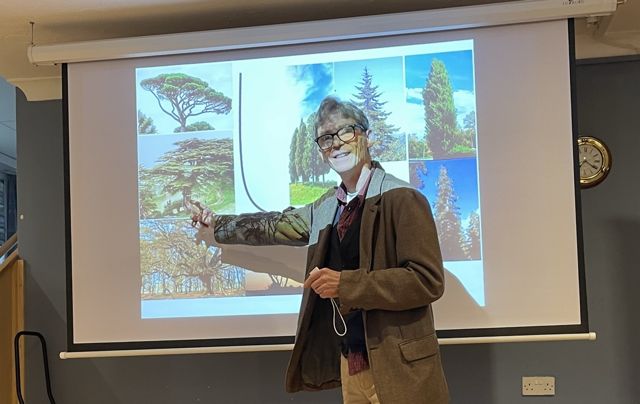
I failed to take a photograph! So attach one here of Peter talking about woods and the Savannah hypothesis.

 Kalikellett