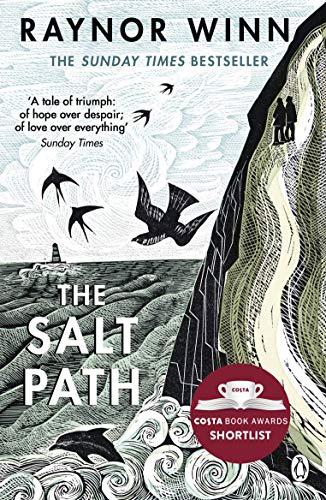
With synchoronous timing, the news that the best seller book and block buster film ‘The Salt Path’ may be a lie, or contain fundamental untruthful elements, (as revealed by the Observer), comes at a time I am preparing for a Socratic Dialogue in the Woods: Why does truth matter.
Although Dialogue form strictly calls on our own experience, I thought I’d dally with this story as I am intrigued by it, and it is a good example of what happens when we are unexpected faced with something we thought was truth and it is a potential lie – or is it? Here are the bones:
Guardian Sally and Tim Walker (AKA Moth and Raynor Winn – why the change of name?), may have misrepresented the events that led to the couple losing their home and that experts had cast doubt over Moth having corticobasal degeneration (CBD).
- In The Salt Path, the couple lose their house due to a bad business investment. But the Observer reported that the couple lost their home after an accusation that Winn had stolen thousands of pounds from her employer.
- The Observer journalist spoke to medical experts who were sceptical about Moth having CBD, given his lack of acute symptoms and his apparent ability to reverse them. According to the NHS medical notes, the author painted a far more severe picture of her husband’s diagnosis than the unusually ‘mild’ form of CBD/CBS that “Moth” suffers from. In the book a death sentence is clear and the idea that the illness is fatal and that “Moth” should not have long to live casts a massive shadow across the book.
- The stories of the people harmed by “Raynor” and “Moth” are conveniently erased from the tale;
- We don’t hear about the land in France where the couple could have gone to stay, instead of being forced – as the book and film depict – to live wild.
- The Observer published a story “The real Salt Path: how a blockbuster book and film were spun from lies, deceit and desperation.” Written by investigative reporter Chloe Hadjimatheou, it alleges that Ros Hemmings, a widow in her 60s living in rural North Wales, “knew something about Winn that almost everyone – her publishers, her agents, the film producers – had missed. She knew that Raynor Winn wasn’t her real name and that several aspects of her story were untrue. She also believed she was a thief.”
Now all summer schedules cancelled, let go by the CBD charity and Gigspanner Band
Raynor’s Response is long and complex but her main argument is that: The Salt Path is about what happened to Moth and me, after we lost our home and found ourselves homeless on the headlands of the south west. It’s not about every event or moment in our lives, but rather about a capsule of time when our lives moved from a place of complete despair to a place of hope. The journey held within those pages is one of salt and weather, of pain and possibility. And I can’t allow any more doubt to be cast on the validity of those memories, or the joy they have given so many.
Certainly revelations surrounding Raynor Winn’s memoir feel incredibly complex. How can we judge?
VIEW: The Salt Path Memoirs stir our emotions and seek our sympathy, it feels like a betrayal to hear that we have in some way been manipulated. To some extent, all narratives are constructed and there is no such thing, ever, as “the whole truth”. But it seems in this case that the story that exists outside The Salt Path corrupts any possibility of redemption. For a memoir that captured so many hearts and inspired such profound emotional investment, this sense of deception cuts deep.This controversy reminds us that “emotional truth” is not a substitute for factual integrity.
Intention matters. A slippery slope.
VIEW: I still read the book. It held my attention. It was a well-written page turner. In some ways, it hit on solid shared human truths. In other ways, it was pure fantasy and a bit disingenuous. She’s a good writer — part artist and maybe part con artist. Publishing books is a business, after all. And the Times has a mighty pay wall!
I lovedThe Salt Path, but then I didn’t think it was all real or supposed to be. The terminal Illness that wasn’t, plus the miracle bits with the tortoise etc were obviously embellishments and I accepted them as such. The rest took me in, though. I had no idea that she was a serial deceiver and possibly criminal. I still think it’s a good book. Apparently some bookshops have moved it to the fiction section.
VIEW: I thought the post from Moth’s nephew saying they were both pathological liars and that they leave a trail of destruction wherever they go was really telling.
VIEW: should it have undergone more rigorous scrutiny prior to publication?
Other examples:
- Netflix Apple Cider Vinegar story of Belle Gibson, an Australian “wellness entrepreneur” – a “Gamechanger with brain cancer + food obsession” as she described herself on Instagram – who was convicted in 2017 of misleading and deceptive conduct, her cookbook pulled from shelves
It has reminded me about the very popular book ‘The Man who planted Trees’, by Jean Giono (sold over 1/2 milion). My copy of the book has a forward by Richard Maybey who describes two Jean Giono’s: the shepherd who transformed a desert and the other is the story behind the fable. The publisher, Readers Digest, unlike Penguin in the Salt Path case, did their due diligence and researched the verity of the story, and decommissioned the book, calling Giono a cheat. Giono responded by surrendering his rights to the text: with 4 years there were translations in print in dozens of languages, and the book became a mini classic.
But there is a fundamental difference: The man who planted trees, while many believed him to be real, never said he was real. Elzéard Bouffier is a fictional person. ‘Giono’s intention had been to write a parable about the contrast between human destructiveness and creativity, and tree planting plays both a literal and symbolic role in this’ (Maybey).
Both writers sought to write a story of growth and redemption, but a difference to me is their intention.
Intention.


 Kalikellett